
Area of a triangle
Architects and engineers frequently use triangulation to create strong, stable structures like bridges and roof trusses. Calculating the area of these triangles is essential for determining exactly how much material is needed to cover a surface or withstand a load. Jump to the questions
Practise now
Worksheet preview and key skills
Worksheet preview
Practise area of a triangle with this self-marking maths worksheet.
The interactive worksheet below generates questions, gives instant feedback, and lets students record their score.
What you’ll practise
- Identifying the base and perpendicular height.
- Using area = 1/2 × base × height.
- Multiplying accurately.
- Giving the answer in square units.
Use the interactive worksheet below, or read the Topic guide for the method and worked example.
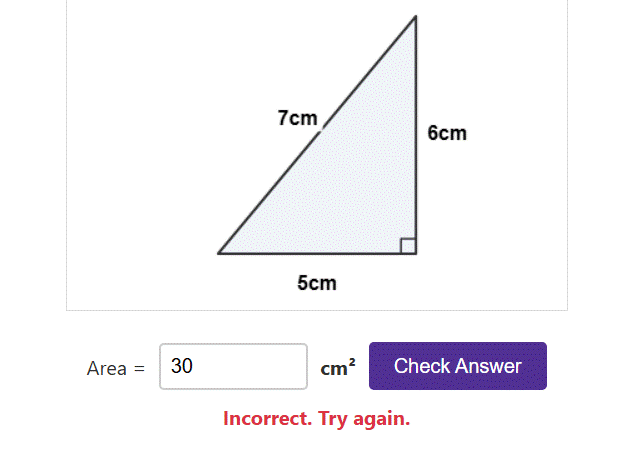
Calculate the area of the triangles below. (Note: Diagrams are not to scale)
Topic guide
What this worksheet practises
This worksheet focuses on calculating the area of a triangle using the standard base and height formula. This is a foundational geometry skill that you will use constantly, from simple compound shapes to complex 3D volume calculations like pyramids and prisms.
Key method
The standard formula is: Area = ½ × base × height, or (base × height) ÷ 2.
- First, identify the base of the triangle. This can be any of the three sides, but it is usually the bottom edge.
- Second, identify the perpendicular height. This is a straight line from the opposite corner dropping down to meet the base at exactly a right angle (90 degrees).
- Multiply the base length by the perpendicular height.
- Finally, halve the result to find the area.
Worked example
Find the area of a triangle with a base of 8 cm and a perpendicular height of 5 cm.
Step 1: Write down the formula.
Area = (base × height) ÷ 2
Step 2: Substitute the known values.
Area = (8 × 5) ÷ 2
Step 3: Multiply the base and height.
8 × 5 = 40
Step 4: Halve the result.
40 ÷ 2 = 20
The area is 20 cm².
Common mistakes to avoid
The two most common errors are forgetting to halve the answer at the end (which gives you the area of a rectangle instead of a triangle), and using a slanted side length as the height. Always ensure the height you use forms a right angle with the base you have chosen.
Things to remember
The height doesn't always have to be inside the triangle. For obtuse triangles, the perpendicular height might be drawn outside the shape, dropping down to an imaginary extended line from the base. The calculation method remains exactly the same.