
Circumference in terms of pi
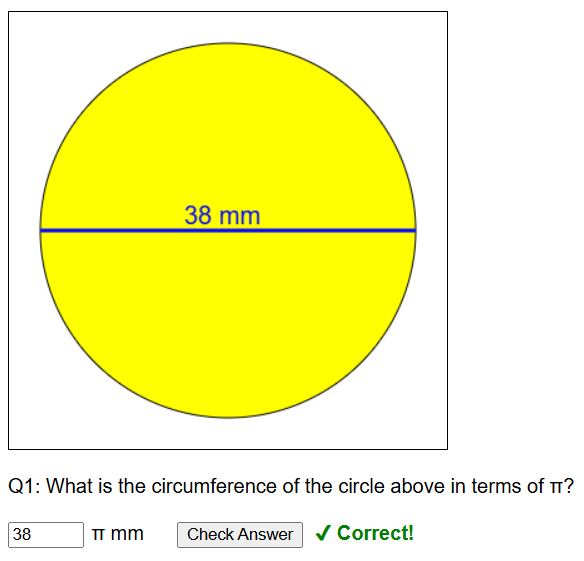
Knowing how to calculate the **circumference of a circle in terms of π** is especially useful when you don’t need a decimal answer—like when working with exact measurements in geometry or algebra. Whether you're designing a circular garden bed or figuring out the track length around a circular field, using π keeps things precise and tidy! Jump to the questions
Practise now
Worksheet preview and key skills
Worksheet preview
Practise circumference in terms of pi with this self-marking maths worksheet.
The interactive worksheet below generates questions, gives instant feedback, and lets students record their score.
What you’ll practise
- Identifying the radius or diameter.
- Using C = πd or C = 2πr.
- Leaving the answer in terms of π.
- Simplifying the coefficient of π where needed.
Use the interactive worksheet below, or read the Topic guide for the method and worked example.
Enter the circumference in terms of π. For example, if the diameter is 8 cm, type 8 (for 8π cm).
Topic guide
What this worksheet practises
This worksheet focuses on finding the circumference of a circle and leaving the answer "in terms of π". This means you do not use a calculator to multiply by 3.1415... Instead, you treat the π symbol like a letter in algebra. This allows for an exact answer without any rounding.
Key method
The formula for the circumference of a circle is C = πd, where 'd' is the diameter.
- Identify the diameter of the circle. If you are only given the radius, double it to find the diameter (d = 2r).
- Substitute the diameter into the formula C = πd.
- Write the number first, followed immediately by the π symbol, exactly as you would write "5x" in algebra.
Worked example
Find the circumference of a circle with a radius of 4 cm. Leave your answer in terms of π.
Step 1: Find the diameter. The radius is 4, so the diameter is double this.
d = 4 × 2 = 8 cm.
Step 2: Substitute into the formula C = πd.
C = π × 8
Step 3: Write in the standard algebraic format.
C = 8π cm.
Common mistakes to avoid
The most common error is forgetting to double the radius when required. Remember that the circumference formula requires the full diameter. Another mistake is using the area formula (πr²) instead of the circumference formula.
Things to remember
If the diameter happens to be 1, the circumference is 1π, but this is correctly written simply as π. Always include units (e.g. cm or m) in your final answer.