
Compound interest increases
Compound interest increases the value of savings or debt by adding interest not just on the original amount, but also on the interest already earned. This concept is the reason savings can grow faster over time—or why unpaid debts can spiral if left unchecked! Jump to the questions
Practise now
Worksheet preview and key skills
Worksheet preview
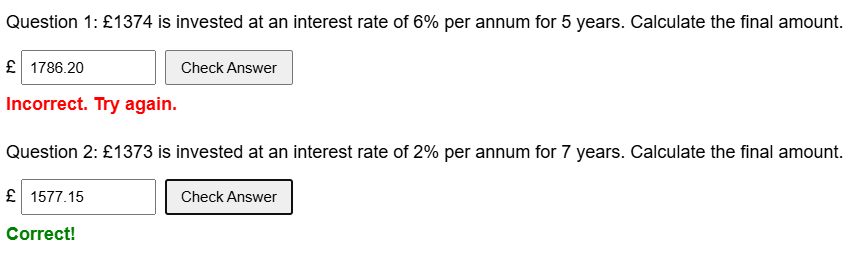
Practise compound interest increases with this self-marking maths worksheet.
The interactive worksheet below generates questions, gives instant feedback, and lets students record their score.
What you’ll practise
- Identifying the starting amount and percentage increase.
- Using a multiplier greater than 1.
- Applying the multiplier repeatedly for several time periods.
- Finding the final amount after compound growth.
Use the interactive worksheet below, or read the Topic guide for the method and worked example.
Calculate the final amount after compound interest is applied. Since it's money, round your answer to two decimal places!
Topic guide
What this worksheet practises
This worksheet provides practice on calculating compound interest. When money is invested in a bank account, it earns interest. With compound interest, you earn interest not only on your original starting amount, but also on the interest you earned in previous years. This creates an exponential growth curve.
Key method
The fastest and most reliable way to calculate compound interest is by using a decimal multiplier.
- First, calculate the multiplier. Add the interest rate percentage to 100%, then divide by 100 to get a decimal.
- Second, identify the time period (usually years). This becomes your power (exponent).
- Third, multiply the initial investment by the multiplier raised to the power of the time period.
- Round your final answer to 2 decimal places, as you are working with money.
Worked example
£4000 is invested at a compound interest rate of 3% per annum. Calculate the total value after 5 years.
Step 1: Find the multiplier. 100% + 3% = 103%. As a decimal, this is 1.03.
Step 2: Set up the calculation using the starting amount, the multiplier, and the power of 5.
Value = 4000 × 1.035
Step 3: Calculate the result.
Value = 4637.096...
Step 4: Round to 2 decimal places.
The total value is £4637.10.
Common mistakes to avoid
A frequent mistake is finding the simple interest instead (calculating 3% of 4000, multiplying by 5, and adding it on). That method ignores the fact that your interest also earns interest. Another common error is using a multiplier of 1.3 instead of 1.03 for a 3% increase. 1.3 represents a 30% increase.
How to check your answer
You can use simple interest to find a quick lower bound. 3% of 4000 is 120. Over 5 years, that's 600. So the answer must be slightly more than 4600. Our answer of 4637.10 makes perfect sense.