
Converting metric units of area
Whether you're calculating the size of a garden, a sports pitch, or even the surface area of a country on a map, knowing how to switch between units like mm², cm², m² and km² is a key life skill. This worksheet will help you practise converting between these metric units with precision. Jump to the questions
Practise now
Worksheet preview and key skills
Worksheet preview
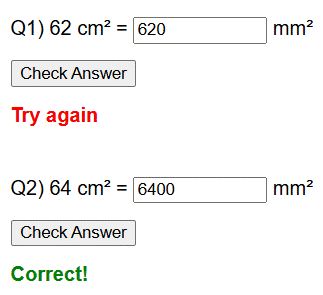
Practise converting metric units of area with this self-marking maths worksheet.
The interactive worksheet below generates questions, gives instant feedback, and lets students record their score.
What you’ll practise
- Converting between square units.
- Remembering that area conversion factors are squared.
- Multiplying or dividing by the correct scale factor.
- Keeping the correct square unit in the answer.
Use the interactive worksheet below, or read the Topic guide for the method and worked example.
Topic guide
What this worksheet practises
This worksheet provides practice on converting metric units of area, such as changing cm² into mm², or m² into cm². Area conversions are tricky because you cannot use standard length conversions (like 1 cm = 10 mm). Because area is 2-dimensional (length × width), the conversion factor must be squared.
Key method
To convert an area, you must square the linear conversion factor.
- First, recall the standard linear conversion (e.g. 1 cm = 10 mm).
- Second, square this conversion to find the area conversion factor. If 1 cm = 10 mm, then 1 cm² = 10² mm² = 100 mm².
- Multiply by this squared factor when converting from a larger unit to a smaller unit.
- Divide by this squared factor when converting from a smaller unit to a larger unit.
Worked example
Convert 4 m² into cm².
Step 1: Recall the standard length conversion.
1 m = 100 cm.
Step 2: Square the conversion to find the area factor.
1 m² = 100 × 100 = 10,000 cm².
Step 3: Multiply the area by the conversion factor.
4 × 10,000 = 40,000.
The answer is 40,000 cm².
Common mistakes to avoid
The overwhelming majority of mistakes happen when students use the linear conversion instead of the area conversion. For example, assuming that 4 m² is 400 cm² (because 1 m is 100 cm). You must always remember that area involves two dimensions, so the conversion multiplier must happen twice (or be squared).
Things to remember
If you forget the squared conversions, draw a quick 1m by 1m square. Its area is 1 m². Now label those same sides in centimetres: 100 cm by 100 cm. The area is 100 × 100 = 10,000 cm². Drawing this instantly proves the conversion factor.