
Converting mixed numbers to improper fractions
Converting mixed numbers to improper fractions is a key skill in mathematics, often used in real-world situations like doubling recipes or measuring materials for construction. It helps you work more easily with fractions when performing calculations like addition, subtraction, or multiplication. Jump to the questions
Practise now
Worksheet preview and key skills
Worksheet preview
Practise converting mixed numbers to improper fractions with this self-marking maths worksheet.
The interactive worksheet below generates questions, gives instant feedback, and lets students record their score.
What you’ll practise
- Multiplying the whole number by the denominator.
- Adding the numerator.
- Keeping the same denominator.
- Writing the result as an improper fraction.
Use the interactive worksheet below, or read the Topic guide for the method and worked example.
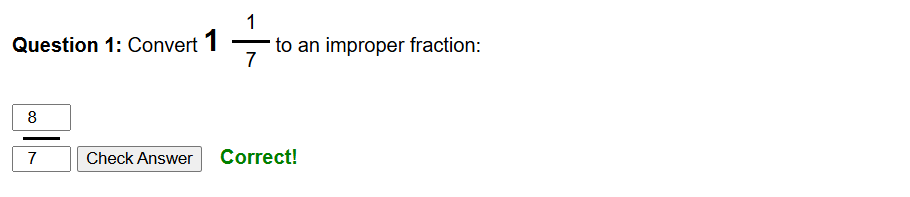
Convert these mixed numbers to improper fractions.
Topic guide
What this worksheet practises
This worksheet provides practice on converting mixed numbers (a whole number and a fraction) into improper fractions (where the top number is bigger than the bottom). This is a crucial first step before multiplying or dividing fractions, as those operations cannot be easily done with mixed numbers.
Key method
To convert a mixed number to an improper fraction, you need to turn the whole number parts into fraction parts of the same size, and add them to the existing fraction.
- Identify the whole number, the numerator (top), and the denominator (bottom).
- Multiply the whole number by the denominator. This tells you how many pieces the whole numbers are made of.
- Add the numerator to this result. This gives you the total number of pieces.
- Write this new total over the original denominator.
Worked example
Convert 3⅖ into an improper fraction.
Step 1: Identify the parts. Whole number = 3, numerator = 2, denominator = 5.
Step 2: Multiply the whole number by the denominator.
3 × 5 = 15.
Step 3: Add the existing numerator.
15 + 2 = 17.
Step 4: Put this over the original denominator.
The answer is 17/5.
Common mistakes to avoid
The most common error is adding instead of multiplying in the first step. For example, calculating 3 + 5 instead of 3 × 5. Always remember: the whole number tells you how many "lots" of the denominator you have.
How to check your answer
To check your work, perform the reverse operation. Divide your new numerator by the denominator. 17 ÷ 5 goes 3 times, with a remainder of 2. So, it is 3 whole ones and 2 leftover fifths (3⅖). This proves your calculation is exactly right.