
Direct proportion to the square root
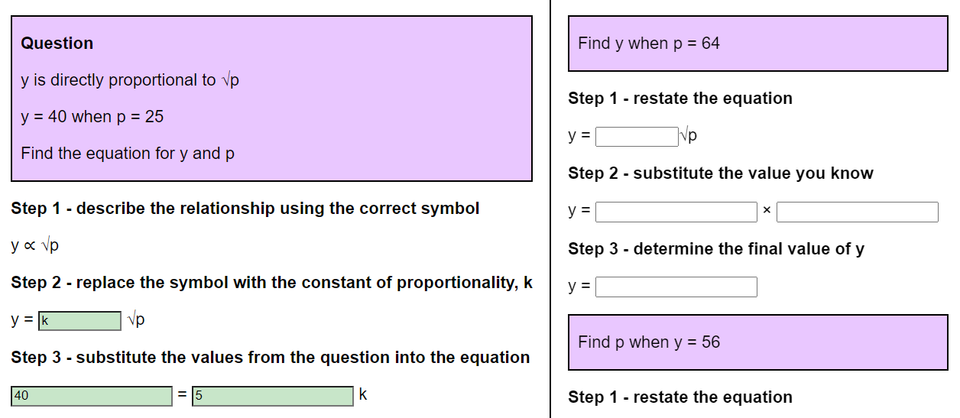
Direct proportion to the square root occurs when one quantity changes in proportion to the square root of another. This concept is useful in physics and engineering, such as understanding the relationship between speed and stopping distance, or pressure and volume in gases. It helps in solving problems where changes happen more gradually as one value grows. Jump to the questions
Practise now
Worksheet preview and key skills
Worksheet preview
Practise direct proportion to the square root with this self-marking maths worksheet.
The interactive worksheet below generates questions, gives instant feedback, and lets students record their score.
What you’ll practise
- Recognising that one quantity is directly proportional to the square root of another.
- Writing a relationship such as y ∝ √x or y = k√x.
- Finding the constant of proportionality.
- Substituting values to find a missing quantity.
Use the interactive worksheet below, or read the Topic guide for the method and worked example.
Topic guide
What this worksheet practises
This worksheet provides practice on direct proportion to the square root of a number. This describes a relationship where one variable grows alongside another, but at a slowing rate. You often see this pattern in physics, such as the relationship between the time it takes an object to fall and the distance it has fallen.
Key method
You must set up an equation using 'k', the constant of proportionality.
- Write the proportionality statement: y ∝ √x.
- Convert this into an equation: y = k√x.
- Substitute the initial pair of known values into the equation to calculate 'k'.
- Write out the full specific equation including your new 'k' value.
- Use this equation to find any other missing values.
Worked example
y is directly proportional to the square root of x. When x = 9, y = 12. Find the equation connecting x and y.
Step 1: Write the general equation.
y = k√x
Step 2: Substitute the known values.
12 = k × √9
Step 3: Calculate the square root.
12 = k × 3
Step 4: Solve for k.
k = 12 ÷ 3 = 4.
Step 5: Write the final specific equation.
y = 4√x.
Common mistakes to avoid
A frequent mistake is applying the square root to 'k' as well as 'x'. The equation is y = k√x, meaning 'k' is multiplied by the root of 'x'. The constant 'k' is never placed inside the square root symbol.
How to check your answer
If you are given a new value of 'x' to substitute into your equation, it will almost always be a square number (like 16, 25, or 100) to keep the calculation clean. If you are trying to square root a number like 14 in a non-calculator exam, you have likely set up the equation incorrectly or substituted the wrong value.