
Division of Integers
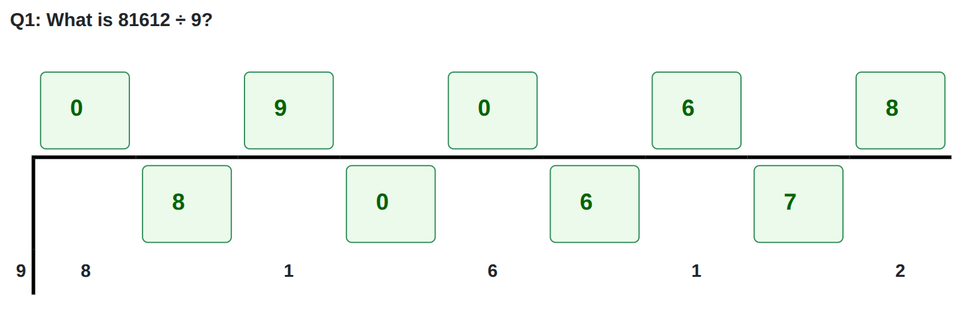
Dividing is a key skill for tasks like splitting bills, calculating unit prices, or converting measurements. It ensures you can break down quantities accurately, which is important in everyday problem-solving. Either practise directly below or try the scaffolded Google Sheet instead.
Looking for division of decimals?
Practise now
Worksheet preview and key skills
Worksheet preview
Practise division of integers with this self-marking maths worksheet.
The interactive worksheet below generates questions, gives instant feedback, and lets students record their score.
What you’ll practise
- Dividing whole numbers.
- Using multiplication facts to support division.
- Finding exact integer quotients.
- Checking division answers.
Use the interactive worksheet below, or read the Topic guide for the method and worked example.
Use short division to find the quotient.
Topic guide
What this worksheet practises
This worksheet provides practice on the division of integers (positive and negative whole numbers). While dividing whole numbers is a core arithmetic skill, adding negative signs introduces a strict set of rules that must be followed to avoid simple sign errors.
Key method
When dividing integers, you must divide the numbers normally first, and then apply a simple rule to determine the sign of the answer.
- Ignore the signs initially and divide the two numbers.
- Look at the original signs of the two numbers.
- If the signs are the same (both positive or both negative), the answer is positive.
- If the signs are different (one positive, one negative), the answer is negative.
Worked example
Calculate −36 ÷ 4 and −42 ÷ −6.
Step 1: Calculate the first division (−36 ÷ 4).
Divide the numbers: 36 ÷ 4 = 9.
Check the signs: We have one negative and one positive. The signs are different.
Therefore, the answer is negative: −9.
Step 2: Calculate the second division (−42 ÷ −6).
Divide the numbers: 42 ÷ 6 = 7.
Check the signs: We have two negative numbers. The signs are the same.
Therefore, the answer is positive: 7.
Common mistakes to avoid
A very common mistake is confusing the rules for addition/subtraction with the rules for multiplication/division. For example, some students think that because −8 + 2 is still negative (−6), then −8 ÷ −2 must also be negative. This is incorrect. The multiplication/division rules ("same signs = positive") are entirely separate from addition rules.
Things to remember
The rules for dividing negative numbers are exactly identical to the rules for multiplying them. "Two negatives make a positive" is a helpful phrase, but remember it only applies when multiplying or dividing.