
Equivalent fractions
Understanding equivalent fractions helps you realise that different-looking fractions can actually represent the same value — like swapping ½ of a chocolate bar with 2 quarters and still getting the same amount! This skill is essential when comparing, simplifying, or adding fractions in real-world contexts like cooking, sharing, and measuring. Jump to the questions
Practise now
Worksheet preview and key skills
Worksheet preview
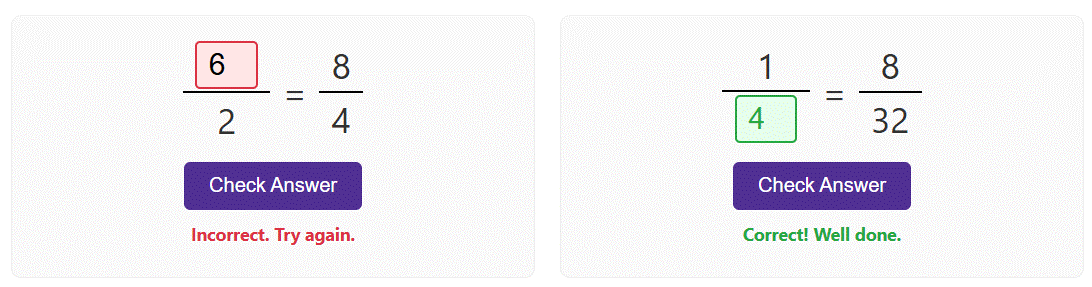
Practise equivalent fractions with this self-marking maths worksheet.
The interactive worksheet below generates questions, gives instant feedback, and lets students record their score.
What you’ll practise
- Multiplying or dividing the numerator and denominator by the same number.
- Recognising fractions with the same value.
- Keeping the fraction equivalent.
- Comparing different forms of the same fraction.
Use the interactive worksheet below, or read the Topic guide for the method and worked example.
Topic guide
What this worksheet practises
This worksheet provides practice on finding equivalent fractions. Equivalent fractions look different but represent the exact same proportion of a whole. Knowing how to create them is the most important skill needed for adding, subtracting, and comparing fractions.
Key method
The golden rule of equivalent fractions is whatever you do to the top, you must do to the bottom.
- To make an equivalent fraction with larger numbers, multiply both the numerator (top) and denominator (bottom) by the exact same whole number.
- To make an equivalent fraction with smaller numbers (simplifying), divide both the top and bottom by the exact same whole number.
- You can only use multiplication and division. You cannot use addition or subtraction.
Worked example
Find the missing number: 3/7 = ?/35.
Step 1: Look at the numbers you know. You have both denominators: 7 and 35.
Step 2: Figure out the multiplier. What do you multiply 7 by to get 35?
7 × 5 = 35. The multiplier is 5.
Step 3: Apply the golden rule. Multiply the top number by the exact same amount.
3 × 5 = 15.
The missing number is 15. The equivalent fraction is 15/35.
Common mistakes to avoid
The most common mistake is adding to the top and bottom instead of multiplying. For example, a student might see 1/2 and think that adding 2 to the top and bottom makes it 3/4. But 1/2 is 50%, while 3/4 is 75%; they are not equivalent. You must always use multiplication or division.
Things to remember
You can create an infinite number of equivalent fractions for any given fraction. 1/2 is exactly the same as 5/10, 50/100, and 5000/10000. They all mean "half".