
Estimation
Sometimes in real life, you don’t need the exact answer — just something close enough to make a quick decision. Whether you're splitting the bill at a restaurant or checking if you've got enough cash for shopping, estimating helps you calculate fast and keep things simple. Jump to the questions
Practise now
Worksheet preview and key skills
Worksheet preview
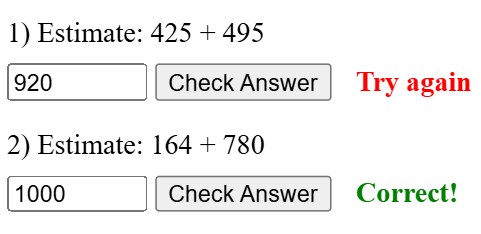
Practise estimation with this self-marking maths worksheet.
The interactive worksheet below generates questions, gives instant feedback, and lets students record their score.
What you’ll practise
- Rounding numbers to make calculations easier.
- Choosing suitable approximations.
- Using estimated values to calculate.
- Checking whether an answer is reasonable.
Use the interactive worksheet below, or read the Topic guide for the method and worked example.
Estimate the answers to the following calculations. Work out the answer by first rounding each number to 1 significant figure.
Topic guide
What this worksheet practises
This worksheet provides practice on estimation. Estimation is not about guessing; it is a strict mathematical process of simplifying a difficult calculation to find a highly accurate approximate answer. This is usually required on non-calculator exam papers.
Key method
The standard rule for estimation is to round every single number in the calculation to one significant figure (1 sig fig) before doing any maths.
- Look at each number individually. Find its first non-zero digit.
- Look at the next digit to decide whether to round up or stay the same.
- Replace all other digits with place-holding zeroes.
- Once every number has been rounded to 1 sig fig, perform the calculation.
Worked example
Estimate the answer to (41.2 × 19.8) ÷ 0.48.
Step 1: Round every number to 1 significant figure.
41.2 rounds to 40.
19.8 rounds to 20.
0.48 rounds to 0.5.
Step 2: Rewrite the calculation with the rounded numbers.
(40 × 20) ÷ 0.5
Step 3: Perform the calculation.
40 × 20 = 800.
800 ÷ 0.5 = 1600. (Remember: dividing by a half is the same as multiplying by 2).
The estimated answer is 1600.
Common mistakes to avoid
A fatal error is trying to calculate the exact answer first and then rounding the result at the end. An estimation question tests your ability to make the calculation easy; if you try to do long multiplication with 41.2 × 19.8 without a calculator, you are missing the point of the question and will lose marks.
How to check your answer
Review your rounded numbers to see if you can quickly gauge the direction of the error. We rounded 41 down to 40, and 19.8 up to 20. Because one went down and the other went up, the errors somewhat cancel out, meaning our estimate of 1600 should be reasonably close to the true exact value.