
Expanding three brackets
Expanding triple brackets is a key skill in algebra that helps us simplify complex expressions. This technique is often used in areas like physics and engineering to model real-world scenarios, such as calculating the volume of irregular shapes or solving equations involving multiple variables. Jump to the questions
Practise now
Worksheet preview and key skills
Worksheet preview
Practise expanding three brackets with this self-marking maths worksheet.
The interactive worksheet below generates questions, gives instant feedback, and lets students record their score.
What you’ll practise
- Expanding two brackets first.
- Multiplying the result by the third bracket.
- Collecting like terms.
- Writing the final expanded expression.
Use the interactive worksheet below, or read the Topic guide for the method and worked example.
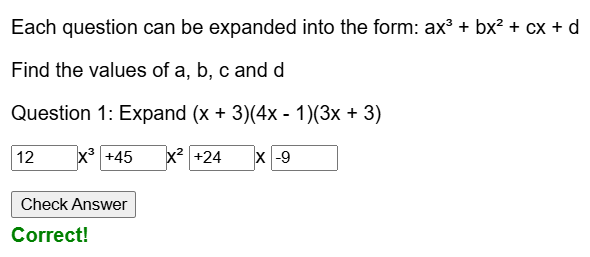
Each question can be expanded into the form: ax³ + bx² + cx + d
Find the values of a, b, c and d
Topic guide
What this worksheet practises
This worksheet focuses on expanding three brackets multiplied together, such as (x+1)(x+2)(x+3). This is a higher-level algebraic skill that results in a cubic expression (containing x³). It requires careful organisation and systematic working to avoid losing terms.
Key method
You cannot expand three brackets all at once. You must break the problem down into two manageable stages.
- Ignore the first bracket entirely for a moment.
- Expand the second and third brackets using the standard FOIL method.
- Simplify this result by collecting the like terms (the 'x' terms in the middle). Put large brackets around this new quadratic expression.
- Bring down the first bracket you ignored earlier.
- Now, multiply the two terms in your first bracket by the three terms in your new large bracket. This will create six separate terms.
- Collect all the like terms (x³, x², x, and numbers) to find your final cubic expression.
Worked example
Expand and simplify (x + 2)(x + 3)(x + 4).
Step 1: Expand the last two brackets: (x + 3)(x + 4).
x² + 4x + 3x + 12 = x² + 7x + 12.
Step 2: Bring down the first bracket to multiply against this new expression.
(x + 2)(x² + 7x + 12).
Step 3: Multiply 'x' by everything in the second bracket.
x³ + 7x² + 12x.
Step 4: Multiply '2' by everything in the second bracket.
+ 2x² + 14x + 24.
Step 5: Write it all out and collect like terms.
x³ + (7x² + 2x²) + (12x + 14x) + 24
The final answer is x³ + 9x² + 26x + 24.
Common mistakes to avoid
A disastrous mistake is trying to multiply the 'x's together and the numbers together, arriving at an answer like x³ + 24. This skips all the cross-multiplication. You must methodically multiply every term by every other term across the brackets.
Things to remember
If you see a question written as (x + 5)³, do not panic. This simply means (x + 5)(x + 5)(x + 5). Write it out in full immediately, and then apply the exact same two-stage method described above.