
Reverse percentages
Reverse percentage calculations are super useful when you’re trying to work backwards from a total that already includes a percentage increase or decrease — like figuring out the original price of an item before a sale, or working out the starting population before a percentage growth. It’s like being a maths detective, uncovering what the number was before the change happened! Jump to the questions
Practise now
Worksheet preview and key skills
Worksheet preview
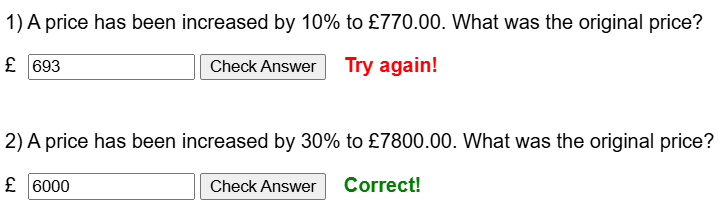
Practise reverse percentages with this self-marking maths worksheet.
The interactive worksheet below generates questions, gives instant feedback, and lets students record their score.
What you’ll practise
- Identifying the final value after a percentage change.
- Using the correct percentage multiplier.
- Working backwards to the original amount.
- Checking whether the original amount should be larger or smaller.
Use the interactive worksheet below, or read the Topic guide for the method and worked example.
Topic guide
What this worksheet practises
This worksheet practises calculating the original amount before a percentage increase or decrease was applied. This is known as reverse percentages. It is a common challenge because you cannot simply subtract the percentage from the final amount.
Key method
To find the original amount, you must work backwards using the percentage multiplier.
- Determine the multiplier for the percentage change. (For example, a 20% increase gives a multiplier of 1.20. A 15% decrease gives a multiplier of 0.85).
- Set up the equation: Original Amount × Multiplier = New Amount.
- Rearrange to find the original amount: Original Amount = New Amount ÷ Multiplier.
Worked example
A jacket is in a sale with 20% off. The sale price is £64. Calculate the original price.
Step 1: Find the multiplier for a 20% decrease. 100% − 20% = 80%, which is 0.80 as a decimal multiplier.
Step 2: Write the equation. Original × 0.80 = 64
Step 3: Divide to find the original amount.
Original = 64 ÷ 0.80 = £80
The original price was £80.
Common mistakes to avoid
A very common error is trying to find 20% of the sale price and adding it back on (e.g., finding 20% of £64, which is £12.80, and adding it to make £76.80). This is incorrect because the original 20% reduction was calculated based on the starting price, not the sale price.