
Sine rule - the ambiguous case
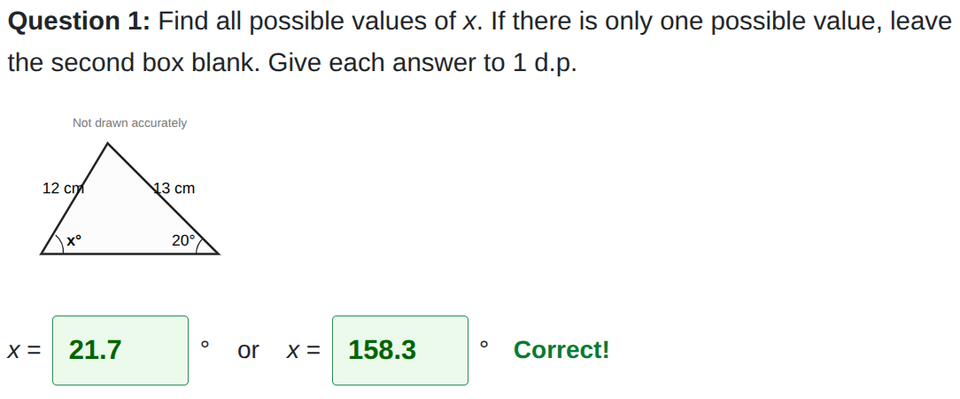
The sine rule can sometimes give two possible angles (see our sine rule visualisation tool). In this worksheet, your job is not just to calculate an angle, but to check whether there is a second possible answer. After finding the first angle, always check its partner angle: 180° − your answer. If that second angle still fits inside the triangle, write both answers. If it makes the angle total go over 180°, reject it. Jump to the questions
Practise now
Worksheet preview and key skills
Worksheet preview
Practise the ambiguous case of the sine rule with this self-marking maths worksheet.
The interactive worksheet below generates questions, gives instant feedback, and lets students record their score.
What you’ll practise
- Recognising the ambiguous case of the sine rule.
- Using inverse sine to find a possible angle.
- Checking whether a second valid angle exists.
- Deciding which angle or triangle is appropriate.
Use the interactive worksheet below, or read the Topic guide for the method and worked example.
Topic guide
What this worksheet practises
This worksheet practises identifying when the ambiguous case of the sine rule occurs, and calculating both possible angles. It also tests your ability to spot when only one angle is mathematically possible.
The key idea
When using the sine rule to find an unknown angle, you are typically given one angle, the side opposite it, and another side.
Because the sine of an angle is positive for both acute and obtuse angles (up to 180°), there can sometimes be two possible answers. This is known as the ambiguous case.
To find out how many valid answers there are, follow this simple check:
- First, calculate the acute angle using inverse sine.
- Next, calculate the supplementary angle by subtracting the acute angle from 180°.
- Finally, check if this supplementary angle can actually fit in the triangle. If the known angle plus the supplementary angle is less than 180°, there are two possible answers.
- If the known angle plus the supplementary angle is 180° or more, there is only one possible answer.
Worked example
In a triangle, angle B is 40°, side b is 10 cm, and side a is 12 cm. Find the possible values of angle A.
First, use the sine rule:
sin A / 12 = sin 40° / 10
sin A = (12 × sin 40°) / 10
sin A ≈ 0.7713
A ≈ 50.5° (to 1 d.p.)
Next, calculate the supplementary angle:
180° − 50.5° = 129.5°
Now, perform the check to see if this second angle is possible. Add it to the known angle:
40° + 129.5° = 169.5°
Because 169.5° is less than 180°, this triangle can exist. Therefore, both 50.5° and 129.5° are possible answers.
Common mistakes to avoid
A common error is automatically assuming that every sine rule question has two answers. If the supplementary angle makes the total angles exceed 180°, it must be rejected.
For example, if the known angle is 70° and the calculated acute angle is 40°, the supplementary angle would be 140°. However, 70° + 140° = 210°, which is impossible for a triangle. So, only the 40° angle is valid.
How to check your answers
Always verify that the sum of your known angle and the supplementary angle is less than 180°. If it is, both answers are valid. Make sure to round your final answers to one decimal place only at the very end of your calculation to avoid rounding errors.