
Two-way tables
Practise completing two-way tables with this self-marking GCSE maths worksheet. Two-way tables are useful for organising information that fits into two categories at once, such as gender and travel method, or year group and favourite activity. Use the row totals, column totals and grand total to work out the missing values, then check your answers instantly. Jump to the questions
Practise now
Worksheet preview and key skills
Worksheet preview
Practise two-way tables with this self-marking maths worksheet.
The interactive worksheet below generates questions, gives instant feedback, and lets students record their score.
What you’ll practise
- Reading information from rows and columns.
- Completing missing totals where needed.
- Using row totals and column totals.
- Answering combined-category questions.
Use the interactive worksheet below, or read the Topic guide for the method and worked example.
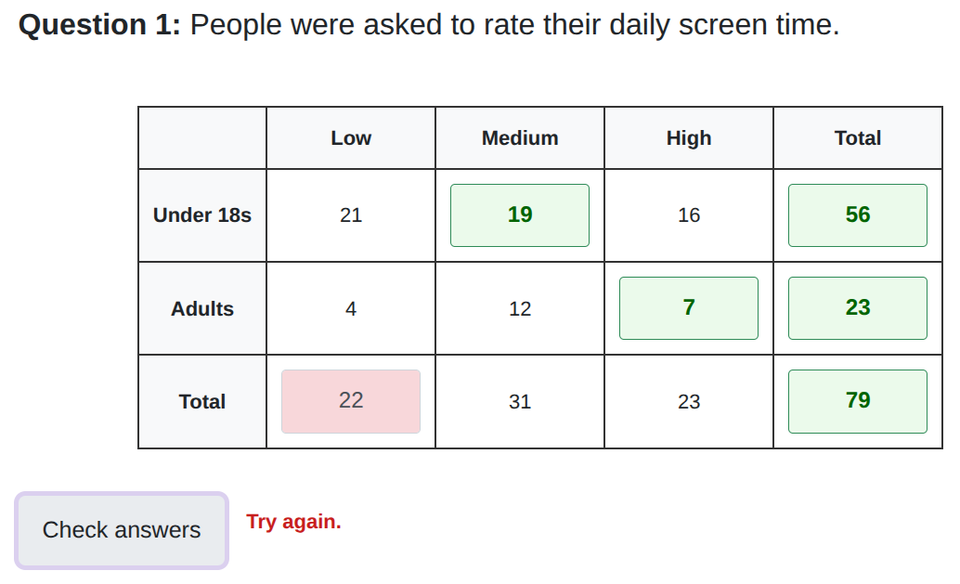
Complete the missing values in each two-way table.
Topic guide
1. What this worksheet practises
This worksheet gives you practice in completing missing values in two-way tables. Two-way tables are used to organise and compare data that fits into two distinct categories at the same time, such as grouping people by their age and their favourite sport. This is a standard topic in GCSE maths that helps you to make sense of surveyed data and extract specific numbers logically.
2. Key method
A two-way table is built on a simple grid system. It consists of inner values and three types of totals:
- Row totals: Found at the end of each row, these are the sum of all the inner values along that horizontal row.
- Column totals: Found at the bottom of each column, these are the sum of all the inner values down that vertical column.
- Grand total: Located in the bottom-right corner, this represents the total number of people or items in the whole survey. It is the sum of the row totals, and also the sum of the column totals.
To find missing values, you need to work backwards using subtraction. Look for a row or column where you already know the total and all but one of the inner values. You can then subtract the known values from the total to find the missing number.
3. Worked example
Imagine a small two-way table showing how 50 students travel to school. The categories are Year 7 and Year 8, and they either walk or take the bus.
We are given the following information:
- Total students (Grand total) = 50
- Total Year 7 students (Row total) = 30
- Year 7 students who walk = 12
- Year 8 students who take the bus = 15
Step 1: Find the Year 7 students who take the bus.
We know there are 30 Year 7 students in total, and 12 of them walk. By using subtraction across the row:
- 30 − 12 = 18
- So, 18 Year 7 students take the bus.
Step 2: Find the total Year 8 students.
We can use the grand total and the Year 7 row total to find the Year 8 row total. Since there are 50 students overall and 30 are in Year 7:
- 50 − 30 = 20
- So, the total for Year 8 is 20 students.
Step 3: Find the Year 8 students who walk.
Now we know the Year 8 row total is 20, and 15 of them take the bus. By using subtraction across the row again:
- 20 − 15 = 5
- So, 5 Year 8 students walk.
4. Useful tips
- Never guess: Every missing value in a well-written two-way table can be found using arithmetic. Do not guess or use trial and error. If a cell seems impossible to find, look at the other rows, columns, or the grand total first. You might need to find a different value before the one you are looking at becomes solvable.
- Look for single gaps: Always target a row or column that has exactly one missing piece of information.
- Use the grand total: The grand total is incredibly useful. If you have the grand total and one row total, you can subtract to find the other row total immediately.
5. Common mistakes to avoid
- Confusing rows and columns: Ensure you are tracking values horizontally for row totals and vertically for column totals. Mixing these up will lead to incorrect deductions.
- Adding instead of subtracting: Remember that you are working backwards from a total to find a missing part. Adding the given inner value to the total will result in a number that is far too large.
- Ignoring the bottom-right corner: Students often get stuck when they focus entirely on the inner cells. The grand total is often the key to unlocking the rest of the table.
6. How to check your answer
Once you have filled in all the missing values, you can run a final check on your work. This is the best way to guarantee you have made no arithmetic errors:
- Add up the numbers horizontally. Every row should add up exactly to its row total.
- Add up the numbers vertically. Every column should add up exactly to its column total.
- Finally, add your row totals together, and then add your column totals together. Both calculations must agree and give you the exact grand total.