
Adding and subtracting mixed number fractions
Adding and subtracting mixed number fractions is a vital skill in everyday life, from following recipes to calculating measurements in DIY projects. It combines fractions and whole numbers, helping you solve real-world problems with precision and confidence! Jump to the questions
Practise now
Worksheet preview and key skills
Worksheet preview
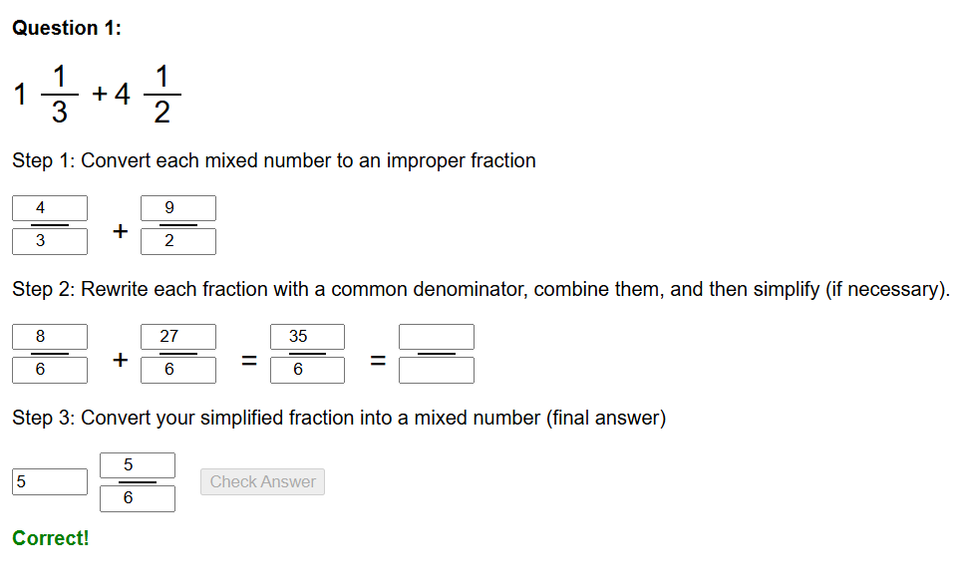
Practise adding and subtracting mixed number fractions with this self-marking maths worksheet.
The interactive worksheet below generates questions, gives instant feedback, and lets students record their score.
What you’ll practise
- Converting mixed numbers to improper fractions where useful.
- Finding common denominators if needed.
- Adding or subtracting the fractions carefully.
- Converting or simplifying the final answer where appropriate.
Use the interactive worksheet below, or read the Topic guide for the method and worked example.
Convert each mixed number to an improper fraction, rewrite them with a common denominator (and simplify), then convert the final result to a mixed number in its simplest form.
Topic guide
What this worksheet practises
This worksheet provides focused practice on adding and subtracting mixed number fractions. Before you can combine mixed numbers, you usually need to convert them into improper fractions and ensure they share a common denominator. This builds directly on your basic fraction arithmetic.
Key method
When adding or subtracting mixed numbers, a reliable method is to convert everything to improper fractions first. This avoids confusion when subtracting a larger fraction part from a smaller one.
- First, convert both mixed numbers into improper fractions. Multiply the whole number by the denominator and add the numerator.
- Second, find a common denominator for the two fractions.
- Third, adjust the numerators accordingly and perform the addition or subtraction on the numerators only. Keep the denominator the same.
- Finally, simplify the resulting fraction and convert it back into a mixed number if necessary.
Worked example
Calculate 2¼ − 1½
Step 1: Convert to improper fractions.
2¼ becomes 9/4.
1½ becomes 3/2.
Step 2: Find a common denominator. The lowest common multiple of 4 and 2 is 4. Multiply the numerator and denominator of 3/2 by 2.
3/2 = 6/4.
Step 3: Subtract the numerators.
9/4 − 6/4 = 3/4.
The answer is 3/4.
Common mistakes to avoid
A common mistake is trying to subtract the whole numbers and the fraction parts separately without checking if the first fraction part is smaller than the second. For example, in 3¼ − 1½, doing 3 − 1 = 2 and then struggling with ¼ − ½ often leads to errors. Converting to improper fractions entirely removes this risk.
How to check your answer
You can quickly estimate the answer using the whole numbers. If you are calculating 4½ − 2¾, you know the answer should be slightly less than 2 (since 4 − 2 = 2, and ¾ is larger than ½). If your final calculated answer is 3¼, your estimate tells you something went wrong.