
Factorising quadratic expressions
Factorising quadratic expressions is a key skill in algebra that helps break down complex equations into simpler parts. It's like finding the ingredients of a recipe—useful in solving equations, understanding graphs, and even in real-world scenarios like calculating areas or optimizing designs. Jump to the questions
Practise now
Worksheet preview and key skills
Worksheet preview
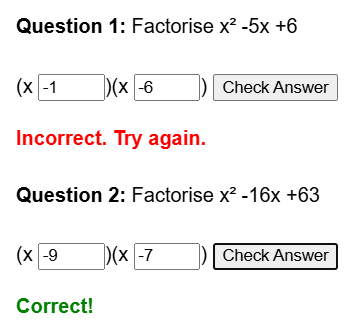
Practise factorising quadratic expressions with this self-marking maths worksheet.
The interactive worksheet below generates questions, gives instant feedback, and lets students record their score.
What you’ll practise
- Finding factor pairs.
- Rewriting a quadratic as two brackets.
- Checking expansion gives the original expression.
Use the interactive worksheet below, or read the Topic guide for the method and worked example.
Factorise the following quadratic expressions into two brackets. Enter only the constants (including their signs) for each bracket.
Topic guide
What this worksheet practises
This worksheet covers factorising quadratic expressions into double brackets. A typical quadratic expression takes the form x² + bx + c, and factorising is the exact reverse of expanding double brackets.
Key method
To factorise x² + bx + c, you need to find two numbers that fit into the brackets (x + p)(x + q).
- Write out your two empty brackets: (x )(x )
- Look at the final number (c). List out its factor pairs.
- Find which pair of factors adds together to make the middle number (b).
- Place those two numbers inside the brackets.
Worked example
Factorise x² + 7x + 10
Step 1: Write the brackets: (x )(x )
Step 2: List the factors of 10. The pairs are (1, 10) and (2, 5).
Step 3: Which pair adds to make 7? 2 + 5 = 7, so the pair is 2 and 5.
Step 4: Fill the brackets.
(x + 2)(x + 5)
Useful tips
Pay close attention to negative signs. If the final number (c) is negative, one factor must be positive and one must be negative. If the middle number (b) is negative but the final number is positive, both factors must be negative.