
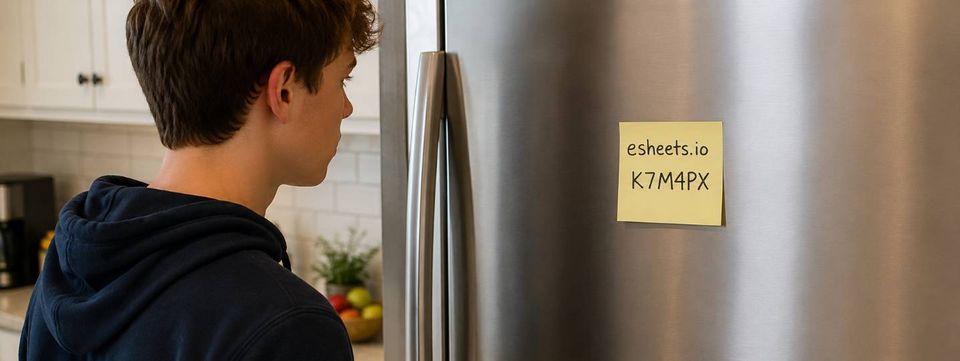
Set maths revision. See whether it was actually completed.
Supporting your child with maths can be difficult.
ESHEETS gives parents a simpler way to set focused maths practice and see the result.
Choose a self-marking worksheet and give your child a short launcher code. When they submit their score, the result appears directly in your ESHEETS dashboard.
No student account is required.
A straightforward way to organise maths revision
The ESHEETS portal was originally developed for teachers and tutors, but it also works well for parents supporting one child at home.
You can:
- select a maths worksheet;
- share a short access code;
- see when a result has been submitted;
- view the latest score and personal best;
- inspect a saved view of your child’s answers;
- return to weaker topics later.
You do not need to build a complicated homeschool timetable or become an unpaid head of mathematics.
The portal simply gives you a little more structure—and considerably more evidence than asking, “Have you done your maths?”
How it works
1. Choose a topic
Browse the ESHEETS worksheet library and select the skill your child needs to practise.
Worksheets cover a growing range of secondary-school topics, including:
- arithmetic;
- fractions, decimals and percentages;
- ratio and proportion;
- algebra;
- graphs;
- geometry and measures;
- probability;
- statistics;
- Higher-tier GCSE topics.
Each worksheet is self-marking, so your child receives immediate feedback while working.
2. Create a task
Inside the portal, create a task using the worksheet you have selected.
The portal generates a short launcher code for your child.
3. Give your child the code
Your child simply visits esheets.io, clicks "Enter Code" and begins the worksheet.
They do not need to create an account, remember a password or provide an email address.
4. View the submitted result
When your child records their score, the result appears in your dashboard.
You can see whether the task was completed, the submitted score and their personal best for that task.
You'll be able to see the questions, their answers and also an answer sheet. This can help you distinguish between:
- a topic they genuinely do not understand;
- one small mistake;
- unfinished work;
- a task that may deserve another conversation.
What should my child practise?
The best revision topic depends on their current level and target grade.
As a broad rule:
- a student aiming for grade 4 should concentrate mainly on grade 3 and grade 4 topics;
- a student aiming for grade 5 should concentrate mainly on grade 4 and grade 5 topics;
- a student aiming for grade 7 should concentrate mainly on grade 6 and grade 7 topics.
They should still repair important gaps from earlier grades, but most revision time should be spent around the level they are trying to reach.
Read our detailed guide:
Which GCSE Maths Topics Should My Child Practise for Their Target Grade?
This includes suggested topic areas for students aiming for grades 4, 5 and 7, with links to relevant ESHEETS worksheets.
How much revision should I set?
More is not automatically better.
A short, focused task completed properly is usually more useful than an hour spent staring at a page while gradually developing strong opinions about the person who set it.
For ordinary weeks, try one or two clearly defined tasks rather than setting a large collection all at once.
A useful routine might be:
- one focused worksheet on a weak topic;
- a second attempt several days later;
- some mixed exam questions at the weekend;
- occasional timed papers closer to mocks or GCSE exams.
The portal can help you see whether the practice is taking place, but the amount should remain realistic.
Read:
How Much Maths Revision Should My Child Be Doing?
What if I cannot explain the method?
You do not need to teach anything yourself.
ESHEETS worksheets include a video guide, a written topic guide, explanations and worked examples - and immediate marking!
As a parent, your most useful role is often to:
- help your child choose a sensible topic;
- encourage them to attempt the questions independently;
- ask where they became stuck;
- help them check errors;
- decide whether the topic needs further practice;
- contact their teacher or tutor when a proper explanation is needed.
Trying to introduce an entirely different method at the kitchen table can occasionally produce more confusion than enlightenment.
Read:
How to Help Your Child with Maths Without Confusing Them
Does my child need extra support?
One poor test or difficult homework session is not necessarily a problem.
It may be worth taking further action if your child regularly:
- says they are simply bad at maths;
- avoids maths whenever possible;
- takes an unusually long time over routine homework;
- follows examples but cannot begin a similar question;
- has basic gaps affecting several topics;
- receives falling results despite apparent effort;
- requires reassurance after every line.
The portal can help you identify patterns, but it cannot diagnose the cause by itself.
Read:
Seven Signs Your Child May Need Extra Help with Maths
Foundation or Higher?
The choice between Foundation and Higher GCSE Maths can create a surprising amount of family anxiety.
Foundation is not automatically a sign of low ambition, and Higher is not automatically the better entry.
The right tier depends on:
- the grades your child needs;
- their current assessment evidence;
- how securely they are working around grade 4 or 5;
- whether they need access to grades 6–9;
- how well they cope with Higher-tier papers.
Targeted worksheet practice can help address particular gaps, but the final entry decision should be discussed with the school.
Read:
Foundation or Higher Tier GCSE Maths: What Parents Need to Know
Maths practice does not always need to look like homework
Some children respond well to games, puzzles and simulations.
A useful maths game may involve:
- curriculum questions;
- strategy;
- probability;
- planning;
- problem-solving;
- budgeting;
- financial decisions;
- trial and improvement.
ESHEETS includes games and activities such as Maths Melee, Dinky Doink, Zoo Mogul, Trip Tycoon and Bills and Buffers.
These do not replace focused revision, but they can help children experience mathematics in a less conventional setting.
Read:
Maths Games That Actually Help Children Learn
Useful for regular practice—not just exam emergencies
The portal can be used for:
- weekly maths practice;
- catching up after absence;
- revisiting weak topics;
- preparing for school assessments;
- mock-exam revision;
- GCSE revision;
- supporting work set by a tutor;
- keeping some structure during school holidays.
You can keep tasks small and targeted rather than presenting your child with an enormous revision programme on the first day.
A task might simply be:
Complete one worksheet on reverse percentages before Friday.
You can then see the submitted result and decide what should happen next.
Built for privacy and low friction
Children do not need an ESHEETS account.
They access a task using a short launcher code and enter their name when submitting a result.
The portal is intended as a lightweight formative tool rather than a permanent school-record system. Results are retained for a limited period, and task access can be closed when it is no longer needed.
Start setting focused maths practice
ESHEETS gives parents a practical way to move from:
“You should probably do some maths revision.”
to:
“Complete this specific task, using this code, by Friday.”
That is clearer for your child and easier for you to follow up.
Choose a topic. Set the task. Share the code. View the result.