
Factorising harder quadratic expressions
Factorising harder quadratic expressions is a vital skill in algebra. It allows us to break down complex quadratic equations into simpler parts, making it easier to solve or analyze them. This technique is not just about numbers; it plays a critical role in understanding motion, physics, and even economics, where quadratic relationships often emerge. Jump to the questions
Practise now
Worksheet preview and key skills
Worksheet preview
Practise factorising harder quadratic expressions with this self-marking maths worksheet.
The interactive worksheet below generates questions, gives instant feedback, and lets students record their score.
What you’ll practise
- Identifying the coefficient of x².
- Finding factor pairs that give the correct middle term.
- Factorising into two brackets.
- Checking by expanding where useful.
Use the interactive worksheet below, or read the Topic guide for the method and worked example.
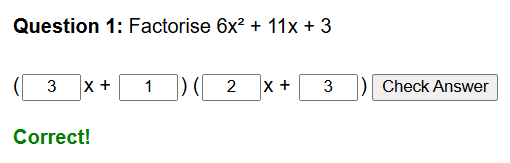
Factorise each quadratic expression. Enter the four numbers (including signs if negative) for the factors in the form (px + q)(rx + s).
Note: If you leave any of the coefficient boxes blank, it will be interpreted as 1.
Topic guide
What this worksheet practises
This worksheet provides practice on factorising harder quadratic expressions. "Harder" quadratics are those where the coefficient of x² (the number in front of the x²) is greater than 1, such as 2x² + 7x + 3. You cannot just find two numbers that multiply to make the end number; a more structured method is required.
Key method
The most reliable way to factorise these expressions is a technique called "splitting the middle term".
- For the expression ax² + bx + c, first multiply 'a' and 'c' together.
- Find two numbers that multiply to make this new 'ac' number, AND add together to make the middle 'b' number.
- Rewrite the original expression, splitting the middle 'bx' term into two separate parts using the numbers you just found.
- Factorise the first pair of terms, and then factorise the second pair of terms.
- You should now have a matching bracket in both parts. This matching bracket becomes one of your final brackets, and the "leftover" terms on the outside make up your second bracket.
Worked example
Factorise 2x² + 11x + 12.
Step 1: Multiply 'a' (2) by 'c' (12).
2 × 12 = 24.
Step 2: Find two numbers that multiply to make 24 and add to make 11.
The factors of 24 are 1&24, 2&12, 3&8, 4&6. The pair that adds to 11 is 3 and 8.
Step 3: Split the middle term (11x) into 8x and 3x.
2x² + 8x + 3x + 12.
Step 4: Factorise the first half (2x² + 8x) and the second half (3x + 12).
2x(x + 4) + 3(x + 4).
Step 5: Notice the matching (x + 4) bracket. Group the outside terms (2x + 3) into their own bracket.
The final answer is (2x + 3)(x + 4).
Common mistakes to avoid
A frequent error is finding the numbers that multiply to make 24 and add to make 11 (which are 3 and 8), and immediately writing the answer as (x + 3)(x + 8). This completely ignores the 2x² at the start. Expanding (x + 3)(x + 8) gives x² + 11x + 24, which is incorrect. You must use the splitting method.
How to check your answer
Always expand your final double brackets in your head using FOIL to see if you arrive back at the original expression. If the first term and the last term don't match, something has gone wrong.