
Solving quadratic equations by factorising
Solving quadratic equations by factorising is like finding the hidden connections in a puzzle. It helps you determine where a parabola crosses the x-axis, which can be useful in physics for calculating projectile motion or in finance for predicting profit trends. It's all about breaking down the equation into simpler pieces to uncover its solutions! Jump to the questions
Practise now
Worksheet preview and key skills
Worksheet preview
Practise solving quadratic equations by factorising with this self-marking maths worksheet.
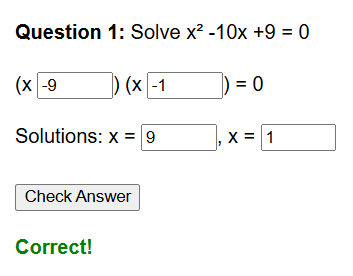
The interactive worksheet below generates questions, gives instant feedback, and lets students record their score.
What you’ll practise
- Setting the quadratic equal to zero.
- Factorising into brackets.
- Setting each bracket equal to zero.
- Finding both solutions.
Use the interactive worksheet below, or read the Topic guide for the method and worked example.
Solve the following quadratic equations by factorising. Enter the factors and the solutions.
Topic guide
What this worksheet practises
This worksheet provides practice on solving standard quadratic equations (x² + bx + c = 0) by putting them into double brackets first. A quadratic equation usually has two different answers (roots) where the curve crosses the x-axis.
Key method
You must factorise the expression first, then flip the signs to find the solutions.
- Ensure the equation equals zero. If it doesn't, rearrange it until it does.
- Look at the number on the end (the constant). Find two numbers that multiply to make this number.
- Check those same two numbers. Do they add together to make the middle number (the coefficient of x)? If so, those are your pair.
- Write out your double brackets: (x + first number)(x + second number) = 0.
- Solve: For the equation to equal zero, one of the brackets must equal zero. Take the number inside each bracket and flip its sign to find your two values for x.
Worked example
Solve x² + 5x + 6 = 0.
Step 1: Check it equals zero. It does.
Step 2: Find two numbers that multiply to make 6, and add to make 5.
The factors of 6 are (1 and 6) or (2 and 3).
2 + 3 = 5, so our numbers are +2 and +3.
Step 3: Put them into brackets.
(x + 2)(x + 3) = 0.
Step 4: Solve by flipping the signs in the brackets.
If x + 2 = 0, then x = −2.
If x + 3 = 0, then x = −3.
The solutions are x = −2 and x = −3.
Common mistakes to avoid
The most tragic mistake is doing all the hard work to factorise into brackets, and then stopping. (x + 2)(x + 3) is an expression, not a solution. The question asks you to "Solve". You must take the final step of pulling the numbers out of the brackets and flipping their signs to get your x values.
Things to remember
If the end number is negative (e.g. x² − 2x − 8 = 0), your two numbers in the brackets must have different signs (one positive, one negative). If the end number is positive but the middle number is negative (e.g. x² − 7x + 10 = 0), both of your numbers in the brackets must be negative.