
Solving harder quadratics by factorising
When solving harder quadratic equations you're tackling problems that come up in fields like physics, engineering, and even video game design. These equations help us model everything from the trajectory of a ball to the behavior of electrical circuits. By mastering these, you’ll unlock tools to analyze and solve more complex real-world problems! Jump to the questions
Practise now
Worksheet preview and key skills
Worksheet preview
Practise solving harder quadratics by factorising with this self-marking maths worksheet.
The interactive worksheet below generates questions, gives instant feedback, and lets students record their score.
What you’ll practise
- Factorising quadratics where the coefficient of x² is not 1.
- Choosing factor pairs carefully.
- Setting each bracket equal to zero.
- Finding both solutions.
Use the interactive worksheet below, or read the Topic guide for the method and worked example.
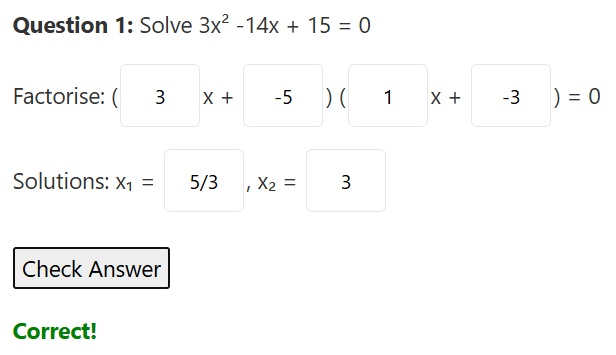
For each quadratic equation, first factorise it (enter the four numbers for the factors) and then enter the two solutions. Answers must be integers or proper/improper fractions (like 1/2, -3/4, etc.).
Note: If you leave any factor coefficient box blank, it will be interpreted as 1.
Topic guide
What this worksheet practises
This worksheet focuses on solving complex quadratic equations where there is a number larger than 1 in front of the x² (e.g. 2x² + 7x + 3 = 0). This requires a more advanced factorising technique before you can find the solutions.
Key method
You must split the middle 'x' term into two separate parts before factorising.
- Identify the numbers a (front), b (middle), and c (end).
- Multiply the front number by the end number (a × c). This gives you your "Target Number".
- Find two numbers that multiply to make your Target Number, AND add to make the middle number (b).
- Rewrite the entire equation, splitting the middle 'b' term into two separate 'x' terms using the two numbers you just found.
- Factorise the first half of the equation, then factorise the second half. The brackets should perfectly match.
- Write out the final double brackets. Set each bracket to equal zero to find your two solutions for x.
Worked example
Solve 2x² + 7x + 3 = 0.
Step 1: Find the Target Number (a × c). 2 × 3 = 6.
Step 2: Find two numbers that multiply to make 6 and add to make the middle number (7). The numbers are 6 and 1.
Step 3: Split the middle term. Rewrite 7x as 6x + 1x.
2x² + 6x + 1x + 3 = 0
Step 4: Factorise the first half (2x² + 6x) and the second half (1x + 3) separately.
2x(x + 3) + 1(x + 3) = 0
Step 5: Form the double brackets. The matching bracket is one, the outside terms form the other.
(x + 3)(2x + 1) = 0
Step 6: Solve. If x + 3 = 0, then x = −3. If 2x + 1 = 0, then 2x = −1, so x = −0.5.
Common mistakes to avoid
The biggest mistake is trying to use the basic quadratic method (just finding numbers that multiply to make 'c' and add to make 'b'). If you just look for numbers that multiply to 3 and add to 7, you will never find them. You must multiply 'a' and 'c' together first.
Things to remember
When solving the final bracket (e.g. 2x + 1 = 0), the quick shortcut is to flip the sign of the number, and divide by the number attached to x. So +1 becomes −1, divided by 2, gives −1/2.