
Adding and subtracting negative numbers
Adding and subtracting negative numbers is crucial when managing things like temperature changes, bank balances, or elevations below sea level. Understanding how to work with negative numbers helps you navigate situations where values decrease or dip below zero. Jump to the questions
Looking for multiplying and dividing negatives instead?
Practise now
Worksheet preview and key skills
Worksheet preview
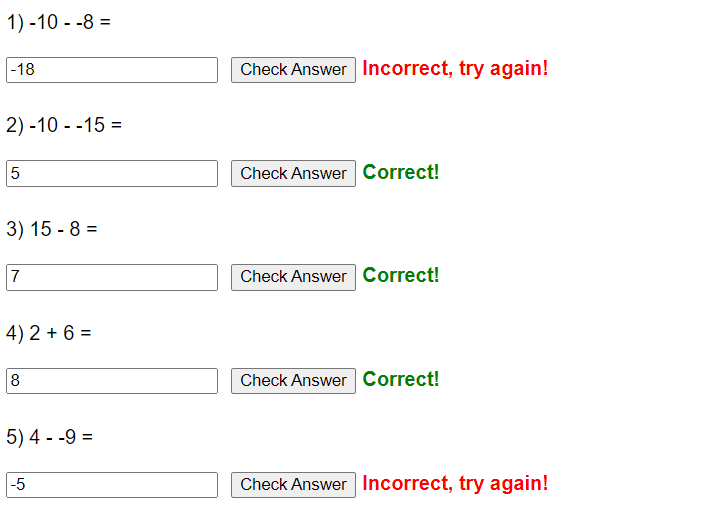
Practise adding and subtracting negative numbers with this self-marking maths worksheet.
The interactive worksheet below generates questions, gives instant feedback, and lets students record their score.
What you’ll practise
- Adding positive and negative numbers.
- Subtracting negative numbers.
- Using a number line or sign rules where helpful.
- Deciding whether the result is positive or negative.
Use the interactive worksheet below, or read the Topic guide for the method and worked example.
Work out the answers to the following problems involving negative numbers.
Topic guide
What this worksheet practises
This worksheet provides practice on adding and subtracting negative numbers (also known as directed numbers). Understanding how positive and negative numbers interact when combined is essential for almost all areas of algebra and data interpretation.
Key method
When adding or subtracting negative numbers, the easiest approach is to look at the two signs immediately next to each other in the middle of the calculation.
- If the two touching signs are the same (e.g. + + or − −), they merge to become a positive or addition sign (+).
- If the two touching signs are different (e.g. + − or − +), they merge to become a negative or subtraction sign (−).
- Once the signs are merged, use a number line in your head. Start at the first number and move right for addition, or left for subtraction.
Worked example
Calculate −5 − (−3)
Step 1: Identify the touching signs. The two negatives in the middle merge into a positive.
−5 + 3
Step 2: Use a number line. Start at −5 and move 3 steps to the right.
−5, −4, −3, −2.
The answer is −2.
Common mistakes to avoid
A very common error is mixing up the rules for addition/subtraction with the rules for multiplication/division. Remember that "− and − makes +" only applies when the signs are touching or when multiplying/dividing. If a question is just −4 − 2, there are no touching signs to merge, so you just start at −4 and move 2 spaces down to −6.
How to check your answer
Think of the calculation in terms of temperature or money. If you have £10 debt (−10) and you take away £5 of debt (− −5), you are effectively gaining £5, leaving you with only £5 of debt (−5). Grounding the numbers in reality often makes errors obvious.