
Multiplying and dividing negatives
Multiplying and dividing negative numbers is important for understanding trends like profit and loss in business or changes in direction in physics. Knowing how these operations work helps you solve problems where values change direction or alternate between positive and negative. Jump to the questions
Looking for adding and subtracting negatives?
Practise now
Worksheet preview and key skills
Worksheet preview
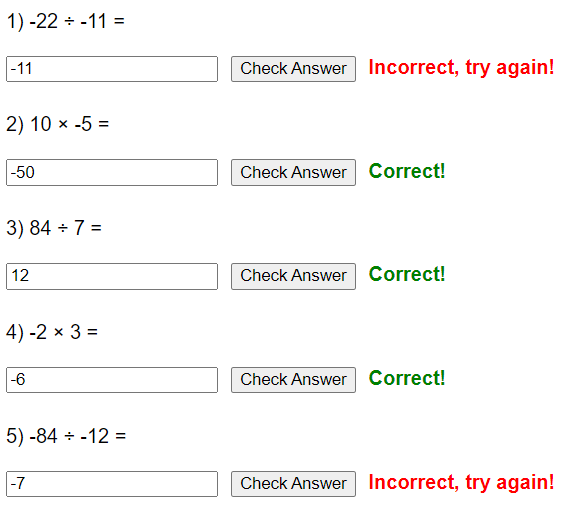
Practise multiplying and dividing negatives with this self-marking maths worksheet.
The interactive worksheet below generates questions, gives instant feedback, and lets students record their score.
What you’ll practise
- Multiplying with positive and negative numbers.
- Dividing with positive and negative numbers.
- Using sign rules for products and quotients.
- Deciding whether the final answer is positive or negative.
Use the interactive worksheet below, or read the Topic guide for the method and worked example.
Work out the answers to the following problems involving negative numbers.
Topic guide
What this worksheet practises
This worksheet focuses on the strict rules for multiplying and dividing when negative numbers are involved. These rules are entirely different from the rules for adding and subtracting negatives (like moving up and down a number line), and confusing the two systems is a major source of error.
Key method
Multiplication and division share the exact same set of rules regarding signs.
- First, ignore the signs entirely and just multiply or divide the bare numbers.
- Second, look at the signs of the two original numbers to determine the sign of your final answer.
- Rule 1 (Same signs): If the signs are the same (both positive OR both negative), the final answer is Positive.
- Rule 2 (Different signs): If the signs are different (one positive, one negative), the final answer is Negative.
Worked example
1) Calculate −8 × −5.
2) Calculate 24 ÷ −3.
Example 1: (−8 × −5)
Step 1: Multiply the numbers: 8 × 5 = 40.
Step 2: Check the signs. They are both negative (same signs). Therefore, the answer is positive.
Final Answer: 40.
Example 2: (24 ÷ −3)
Step 1: Divide the numbers: 24 ÷ 3 = 8.
Step 2: Check the signs. The 24 is positive and the 3 is negative (different signs). Therefore, the answer is negative.
Final Answer: −8.
Common mistakes to avoid
The most devastating mistake is applying the rule "two negatives make a positive" to addition or subtraction. For example, seeing −5 − 3 and claiming the answer is +8. The rule "two negatives make a positive" only applies to multiplication and division. (−5 − 3 is actually −8, because you start at −5 and go down 3).
Things to remember
Squaring a negative number always results in a positive answer. For example, (−6)² literally means −6 × −6. Because both signs are the same (negative), the answer is a positive 36.