
Square roots and fractional powers
Square roots and fractional powers are essential for understanding concepts in geometry, physics, and finance. From calculating the side length of a square to determining the rate of growth, these skills help you break down complex problems and solve them efficiently in the real world. Jump to the questions
Practise now
Worksheet preview and key skills
Worksheet preview
Practise square roots and fractional powers with this self-marking maths worksheet.
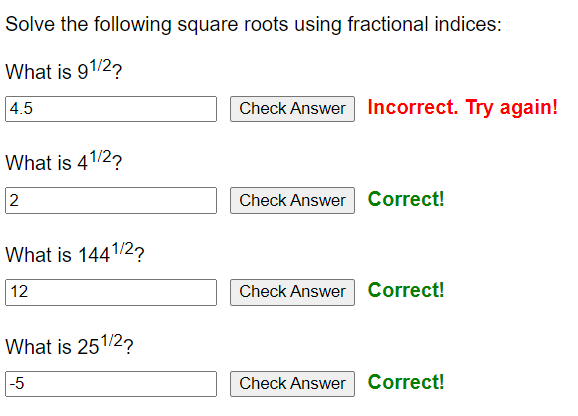
The interactive worksheet below generates questions, gives instant feedback, and lets students record their score.
What you’ll practise
- Recognising that a power of 1/2 means square root.
- Evaluating square roots.
- Rewriting fractional powers as roots.
- Simplifying exact values where possible.
Use the interactive worksheet below, or read the Topic guide for the method and worked example.
Solve the following square roots using fractional indices. You may provide either the positive or negative root.
Topic guide
What this worksheet practises
This worksheet provides practice on fractional indices (powers that are written as fractions, like 1/2 or 1/3). This is an advanced index law that translates powers into different types of roots.
Key method
A fractional power is a disguised instruction to find a root.
- Look at the fraction in the power. The bottom number (the denominator) tells you what type of root to use.
- A power of 1/2 means the "second root", which is just a normal Square Root (√).
- A power of 1/3 means the Cube Root (³√).
- A power of 1/4 means the Fourth Root (&sup4;√), and so on.
- The top number (the numerator) tells you what normal power to raise the final answer to. If it's a 1 (e.g. 1/2), you just find the root and you're done.
Worked example
1) Evaluate 491/2.
2) Evaluate 81/3.
Example 1: (491/2)
Step 1: The power is 1/2. The bottom number is 2, so this means "Square Root".
Step 2: Find the square root of 49.
√49 = 7.
The answer is 7.
Example 2: (81/3)
Step 1: The power is 1/3. The bottom number is 3, so this means "Cube Root".
Step 2: Find the cube root of 8. (What number multiplied by itself three times makes 8?).
2 × 2 × 2 = 8, so the cube root is 2.
The answer is 2.
Common mistakes to avoid
The most devastating mistake is treating the fractional power like a normal multiplication. For example, calculating 491/2 as "half of 49" to get 24.5. This is completely wrong. Powers are not multipliers; they tell you about roots and indices.
Things to remember
If you encounter a fractional power with a number other than 1 on top, like 82/3, you do it in two steps. First, use the bottom number to find the root (cube root of 8 is 2). Then, use the top number to power your answer (2 squared is 4). The final answer is 4.