
Evaluating fractional and negative powers
Evaluating fractional and negative powers is crucial in fields like engineering, physics, and computer science. Fractional powers help in calculating roots, while negative powers are used to represent small values or inverses, making them essential for solving equations and understanding real-world exponential relationships. Jump to the questions
Practise now
Worksheet preview and key skills
Worksheet preview
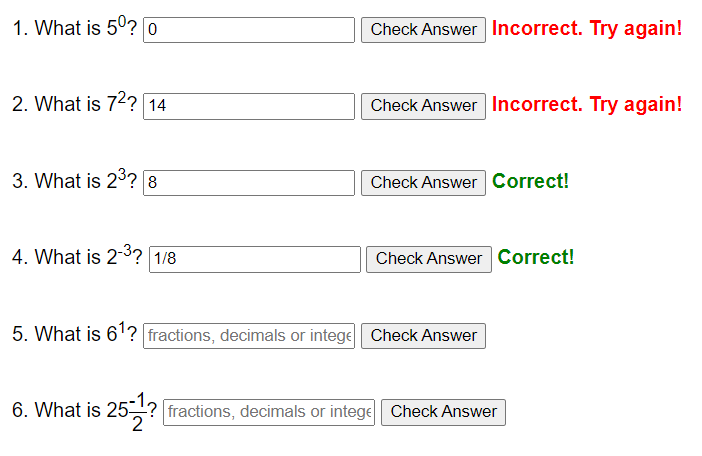
Practise evaluating fractional and negative powers with this self-marking maths worksheet.
The interactive worksheet below generates questions, gives instant feedback, and lets students record their score.
What you’ll practise
- Interpreting fractional indices as roots and powers.
- Interpreting negative indices as reciprocals.
- Applying roots, powers and reciprocals in the correct order.
- Simplifying the final value.
Use the interactive worksheet below, or read the Topic guide for the method and worked example.
Evaluate the following expressions. Answers can be fractions, decimals, or integers. For even fractional roots, you may provide either the positive or negative root.
Topic guide
What this worksheet practises
This worksheet provides practice on evaluating numbers raised to powers that are both fractional and negative. This is one of the highest-level indices skills at GCSE. It combines three separate operations: a root, a power, and a reciprocal.
Key method
Tackle the index one piece at a time. A power in the format −a/b means three things:
- The denominator 'b' tells you the root. (e.g. 2 means square root, 3 means cube root). Apply this first.
- The numerator 'a' tells you the standard power. Apply this second.
- The negative sign means reciprocal (flip the number upside down). Apply this last.
Worked example
Evaluate 8−2/3.
Step 1: Deal with the denominator of the fraction (the root). The denominator is 3, which means cube root.
³√8 = 2.
Our problem is now 2−2.
Step 2: Deal with the numerator of the fraction (the standard power). The numerator is 2, which means square it.
2² = 4.
Our problem is now 4−1.
Step 3: Deal with the negative sign. A negative power means reciprocal (1 over the number).
The reciprocal of 4 is 1/4.
The final answer is 1/4.
Common mistakes to avoid
The most common mistake is thinking the negative power means the final answer should be a negative number (e.g. giving an answer of −4). A negative power has absolutely nothing to do with negative numbers; it only means "flip the fraction".
Things to remember
Always do the root first. In the example above, you could have squared 8 first to get 64, and then found the cube root of 64 to get 4. However, doing the root first makes the numbers smaller and much easier to work with mentally.