
Adding and subtracting decimals
Adding and subtracting decimals is a useful skill in everyday life, from calculating money to measuring ingredients in a recipe. By learning how to handle decimals, you’ll be better equipped to solve real-world problems that require precise calculations! Jump to the questions
Practise now
Worksheet preview and key skills
Worksheet preview
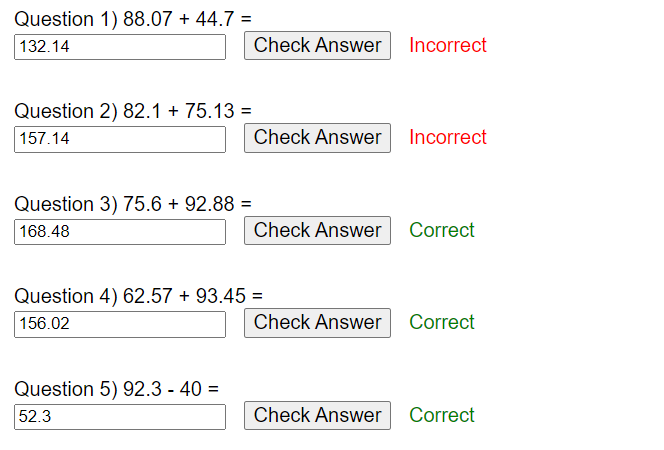
Practise adding and subtracting decimals with this self-marking maths worksheet.
The interactive worksheet below generates questions, gives instant feedback, and lets students record their score.
What you’ll practise
- Lining up decimal points.
- Using place value columns.
- Adding or subtracting digits carefully.
- Keeping the decimal point in the correct place.
Use the interactive worksheet below, or read the Topic guide for the method and worked example.
Topic guide
What this worksheet practises
This worksheet covers adding and subtracting numbers that include decimal points. The key to success is keeping your place values correctly aligned.
Key method
When using column addition or subtraction with decimals, follow these rules:
- Line up the decimal points exactly on top of each other. This ensures the units, tenths, and hundredths columns are all properly aligned.
- If the numbers have different amounts of decimal places, fill in the empty spaces with placeholder zeros.
- Add or subtract starting from the column furthest to the right, just as you would with whole numbers.
- Remember to write the decimal point in your final answer, directly below the other decimal points.
Worked example
Calculate 14.5 + 3.82
Step 1: Line up the numbers by their decimal points.
Step 2: Add a placeholder zero to 14.5 so both numbers have two decimal places (14.50).
Step 3: Add the columns from right to left:
- Hundredths: 0 + 2 = 2
- Tenths: 5 + 8 = 13 (write down 3, carry over 1)
- Units: 4 + 3 + 1 (carried) = 8
- Tens: 1 + 0 = 1
The answer is 18.32.
Common mistakes to avoid
Never line up numbers by their right-hand edge if it means the decimal points are mismatched. For example, adding 12.3 and 4.56 without lining up the decimals will scramble the place values and result in the wrong answer.
Things to remember
Placeholder zeros are particularly helpful when subtracting a decimal from a whole number. For example, to calculate 10 − 2.45, write the whole number as 10.00 to make the subtraction clear.