
Index laws of multiplication
The index laws of multiplication are important for simplifying expressions involving powers. They allow you to efficiently handle large numbers and complex calculations in fields like algebra, physics, and computer science. By mastering these laws, you can solve problems involving repeated multiplication in a much faster and more organized way. Jump to the questions
Practise now
Worksheet preview and key skills
Worksheet preview
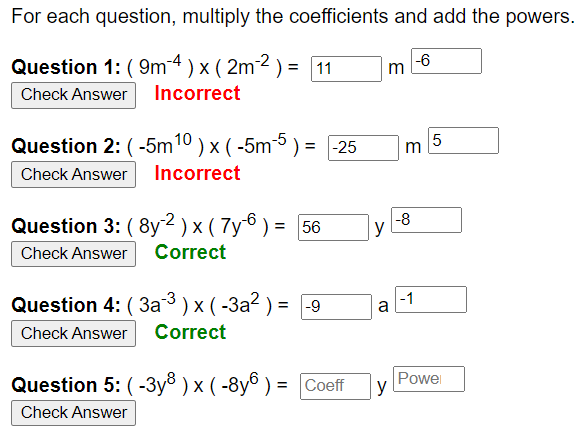
Practise index laws of multiplication with this self-marking maths worksheet.
The interactive worksheet below generates questions, gives instant feedback, and lets students record their score.
What you’ll practise
- Multiplying terms with the same base.
- Adding indices when bases match.
- Keeping the base unchanged.
- Simplifying expressions using the multiplication index law.
Use the interactive worksheet below, or read the Topic guide for the method and worked example.
For each question, multiply the coefficients and add the powers. Enter your answers in the input boxes.
Topic guide
What this worksheet practises
This worksheet focuses on the index law for multiplication. When you multiply two algebraic terms or numbers that share the exact same base, you can simplify the expression by manipulating their powers (indices).
Key method
The core rule is: when multiplying terms with the same base, you add the powers together.
- Verify that the "bases" (the large numbers or letters) are identical. For example, in a&sup4; × a³, the base is 'a'.
- Keep the base exactly the same in your answer.
- Take the power of the first term and add it to the power of the second term.
- If there are large numbers (coefficients) at the front of the terms (e.g. 4x&sup5; × 3x²), multiply those normal numbers normally first (4 × 3 = 12), and then add the powers of the letters.
Worked example
Simplify 4m&sup5; × 6m³.
Step 1: Multiply the large normal numbers at the front.
4 × 6 = 24.
Step 2: Look at the algebraic terms with the 'm' base. Apply the addition rule to their powers.
5 + 3 = 8.
So, m&sup5; × m³ becomes m&sup8;.
Step 3: Combine the two parts together.
The final answer is 24m&sup8;.
Common mistakes to avoid
The most devastating mistake is multiplying the powers together instead of adding them. For example, seeing x&sup4; × x³ and writing x¹². The powers must be added (to give x&sup7;). Writing out the sum in full shows why: (x·x·x·x) multiplied by (x·x·x) gives a total of seven 'x's in a row.
Things to remember
Be very careful with negative indices. If you are asked to simplify x&sup5; × x&supmin;², you are adding a negative number (5 + −2). This actually results in a subtraction, giving an answer of x³.