
Multiplying decimals
Multiplying decimals is essential when dealing with tasks like scaling recipes, calculating discounts, or finding the area of a space. Mastering this skill helps you handle situations that require accuracy in measurements and quantities. Jump to the questions
Video on multiplying decimals using grid method
Practise now
Worksheet preview and key skills
Worksheet preview
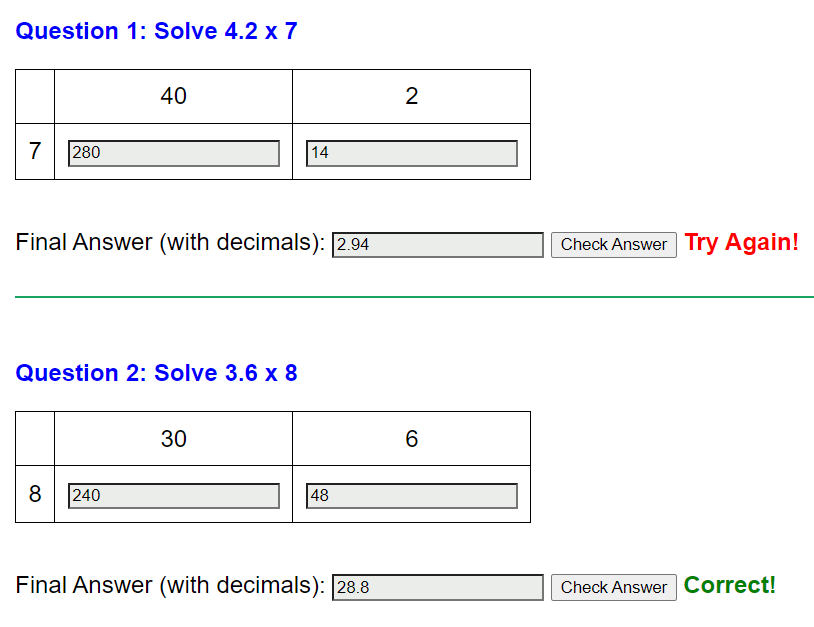
Practise multiplying decimals with this self-marking maths worksheet.
The interactive worksheet below generates questions, gives instant feedback, and lets students record their score.
What you’ll practise
- Multiplying the numbers as whole numbers first where useful.
- Counting decimal places.
- Placing the decimal point correctly.
- Checking the size of the final answer.
Use the interactive worksheet below, or read the Topic guide for the method and worked example.
Topic guide
What this worksheet practises
This worksheet provides practice on multiplying two decimal numbers together. Attempting to use a standard column method directly with decimals is highly prone to error. Instead, we remove the decimals entirely, multiply as normal whole numbers, and then put the decimal point back at the very end.
Key method
The "counting decimal places" method is the most reliable way to multiply decimals.
- First, completely ignore the decimal points. Treat both numbers as whole integers.
- Multiply these two whole integers together using your preferred method (e.g. grid method or column method).
- Now, look back at the original question. Count the total number of digits that sit after the decimal points in both of the original numbers combined.
- Place the decimal point into your final answer so that it has the exact same total number of decimal places as the original question.
Worked example
Calculate 0.4 × 1.2.
Step 1: Ignore the decimals and write the whole numbers.
4 × 12.
Step 2: Multiply the whole numbers.
4 × 12 = 48.
Step 3: Count the decimal places in the original question (0.4 × 1.2).
There is one digit after the point in 0.4 (the 4). There is one digit after the point in 1.2 (the 2).
Total decimal places = 2.
Step 4: Put the decimal point into the answer (48) so it has 2 decimal places.
We need to place it in front of the 4 to create two places: .48
We add a zero at the front for clarity.
The final answer is 0.48.
Common mistakes to avoid
The most common mistake is lining up the decimal points in a column multiplication and just dropping the point straight down into the answer. While this works perfectly for addition and subtraction, it is completely wrong for multiplication. You must count the total decimal places instead.
How to check your answer
Use estimation. 0.4 is a bit less than a half. 1.2 is a bit more than 1. So, half of 1 is 0.5. Our calculated answer of 0.48 is extremely close to 0.5, which proves our decimal point is in exactly the right place. If we had written 4.8 or 0.048, our estimate would immediately flag it as wrong.