
Addition and Subtraction
Practise adding and subtracting positive whole numbers, from two-digit calculations to larger column methods and mixed calculations. The worksheet also includes a missing-digit calculation and a short problem to help you use these skills confidently. Jump to the questions
Practise now
Worksheet preview and key skills
Worksheet preview
This eight-question worksheet begins with two-digit addition and subtraction, then develops carrying, exchanging and calculations with larger whole numbers.
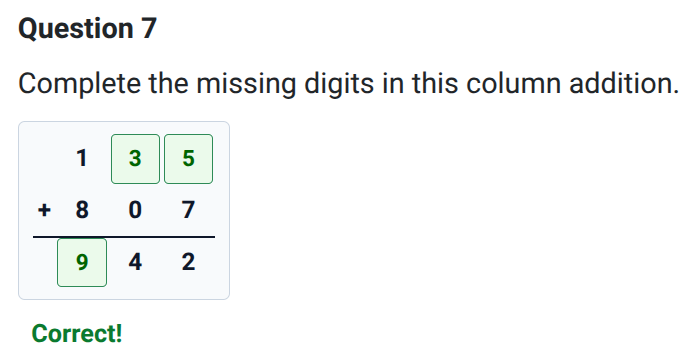
You will also complete a mixed calculation, fill missing digits in a column calculation and solve a short contextual or error-checking question.
What you’ll practise
- Adding two or three positive whole numbers using place value.
- Subtracting with exchanging, including across zero.
- Working through mixed addition and subtraction from left to right.
Use the interactive worksheet below, or read the Topic guide for the method and worked examples.
Addition and Subtraction
Work out each answer using whole numbers. For Question 7, enter one digit in each box.
Topic guide
Adding and subtracting whole numbers
Addition combines amounts to make a total. Subtraction can find what remains or the difference between two amounts. In a column method, line up digits with the same place value: ones under ones, tens under tens, and so on.
Column addition with carrying
Work from right to left. If a column totals 10 or more, write the ones digit and carry the extra ten into the next column.
For example, to calculate 478 + 356:
- Ones: 8 + 6 = 14. Write 4 and carry 1 ten.
- Tens: 7 + 5 + 1 = 13. Write 3 and carry 1 hundred.
- Hundreds: 4 + 3 + 1 = 8.
Therefore, 478 + 356 = 834.
Column subtraction with exchanging
Again, work from right to left. If the top digit is too small, exchange one from the next place-value column. When there is a zero, you may need to move left until you find a digit that can be exchanged.
For example, in 1,002 − 487, exchange across both zeros. The place values become 0 thousands, 9 hundreds, 9 tens and 12 ones.
- Ones: 12 − 7 = 5.
- Tens: 9 − 8 = 1.
- Hundreds: 9 − 4 = 5.
So 1,002 − 487 = 515.
Check subtraction using addition
You can check a subtraction by adding the answer to the number that was subtracted. For the example above, 515 + 487 = 1,002, so the subtraction is correct.
Three addends and mixed calculations
When adding three numbers, line up all three by place value and include any carried digits. For a calculation containing only addition and subtraction, work from left to right.
For example:
860 + 245 − 390 + 175
= 1,105 − 390 + 175
= 715 + 175
= 890
Useful checks
- Estimate first so you know roughly how large the answer should be.
- Keep place-value columns aligned, especially when numbers have different lengths.
- Include carried digits in addition and update exchanged digits in subtraction.
- For missing-digit questions, use each column and any carry or exchange to constrain the blank.