
Angle Facts
Practise the essential angle facts used throughout GCSE geometry: angles on a straight line, around a point and within a right angle, as well as vertically opposite angles.
The questions begin with one-step calculations and build towards diagrams where two or more facts must be combined. Jump to the questions
Practise now
Worksheet preview and key skills
Worksheet preview
This eight-question worksheet practises finding missing angles using the basic angle facts needed at GCSE Foundation.
You will work with clear line diagrams, right-angle markers and angles around a point, then combine facts in the later questions.
What you’ll practise
- Using totals of 90°, 180° and 360°.
- Recognising vertically opposite angles.
- Choosing an angle rule and combining rules in multi-step problems.
Use the interactive worksheet below, or read the Topic guide for the method and worked example.
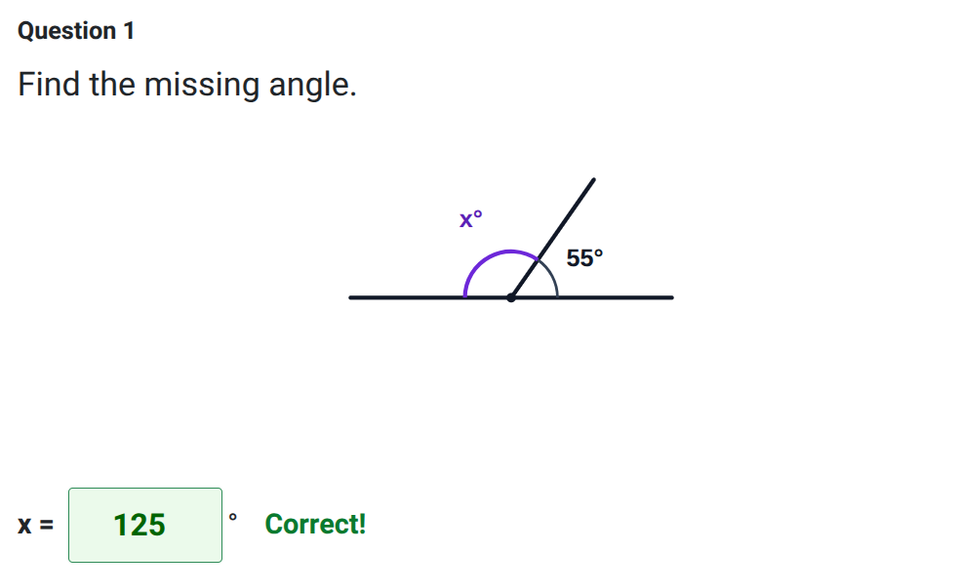
Find each missing angle. Give angle answers in degrees.
Topic guide
The basic angle facts
Angle facts tell you the total or relationship to use before you subtract or compare angles.
- Angles on a straight line total 180°. Two angles with this total are supplementary.
- Angles around a point total 360°.
- Vertically opposite angles are equal when two straight lines cross.
- Angles that make a right angle total 90°. Two angles with this total are complementary.
A reliable method
- Identify the total or equality shown by the diagram.
- Add any known angles that belong together.
- Subtract from 90°, 180° or 360°, or copy the value of a vertically opposite angle.
- Check that your answer is sensible for the marked sector.
Worked examples
Straight line: one angle is 68°. The adjacent angle is 180° − 68° = 112°.
Around a point: three angles are 75°, 95° and 110°. The missing angle is 360° − (75° + 95° + 110°) = 80°.
Combining facts: two straight lines cross. An angle is vertically opposite a 52° angle, so it is also 52°. If it forms a straight line with the required angle, the required angle is 180° − 52° = 128°.
Common mistakes
- Using 180° for angles around a full point instead of 360°.
- Assuming adjacent angles are equal; it is vertically opposite angles that are equal.
- Forgetting to add several known sectors before subtracting from the total.
- Using 180° when a right-angle marker shows that the total is 90°.
Quick recap
Look for the structure first: a right angle means 90°, a straight line means 180°, a full turn means 360°, and opposite angles at an intersection are equal.