
Area of a sector
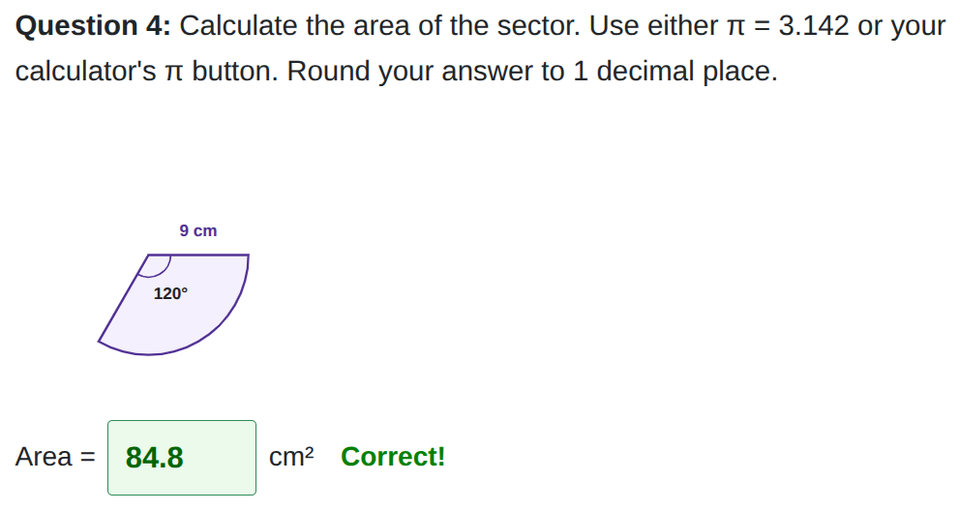
A sector is a slice of a circle, and its area depends on both the radius and the angle at the centre. Use this worksheet to practise calculating sector areas with a calculator and rounding your answers to 1 decimal place. Jump to the questions
Practise now
Worksheet preview and key skills
Worksheet preview
Practise area of a sector with this self-marking maths worksheet.
The interactive worksheet below generates questions, gives instant feedback, and lets students record their score.
What you’ll practise
- Identifying the sector angle and radius.
- Using the fraction angle/360°.
- Applying the fraction to the area of the full circle.
- Giving the answer in square units.
Use the interactive worksheet below, or read the Topic guide for the method and worked example.
Topic guide
What this worksheet practises
This worksheet helps you practise calculating the area of a sector. A sector is a slice of a circle. The angle of the sector tells you what fraction of the full circle you have. The radius is the distance from the centre to the curved edge, and it is used in the circle area part of the calculation.
Key method
To find the area of a sector, you find the fraction of the circle you need using the angle, and then multiply it by the area of the full circle.
The formula for the area of a sector is:
Area of sector = angle ÷ 360 × π × r²
When you calculate your answer, you can use either π = 3.142 or your calculator's π button. Because these values are slightly different, they might give answers that round slightly differently. Both methods are acceptable, and the worksheet will mark either as correct.
Worked example
A sector has a radius of 8 cm and an angle of 90°. Calculate its area to 1 decimal place.
Area = 90 ÷ 360 × π × 8²
Area = 0.25 × π × 64
Area ≈ 50.3 cm²
Useful tips
Always write down your substitution step before typing it into the calculator. This prevents mistakes and makes it easier to check your own work.
Common mistakes to avoid
A frequent error is forgetting to square the radius. Remember that r² means r × r, so 8² is 64, not 16. Another mistake is using the formula for the circumference of a circle instead of the area.
How to check your answer
You can check if your answer is sensible by looking at the fraction. A 90° sector is a quarter of a circle. If the full circle area is roughly 200 cm², your answer should be around 50 cm².