
Pictograms
Pictograms use pictures or symbols to show data, but the key tells you what each symbol is worth. Use this worksheet to practise reading full, half and quarter symbols, then finding totals and comparisons. Jump to the questions
Practise now
Worksheet preview and key skills
Worksheet preview
Practise pictograms with this self-marking maths worksheet.
The interactive worksheet below generates questions, gives instant feedback, and lets students record their score.
What you’ll practise
- Reading the pictogram key.
- Converting symbols into numbers.
- Comparing categories.
- Answering questions using the pictogram.
Use the interactive worksheet below, or read the Topic guide for the method and worked example.
Pictograms
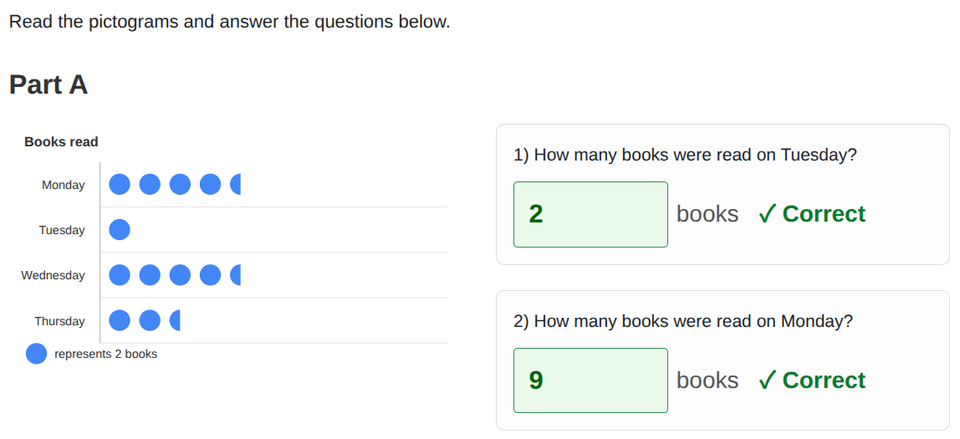
Read the pictograms and answer the questions below.
Topic guide
What this worksheet practises
This worksheet helps you practise reading and interpreting pictograms. A pictogram uses symbols or pictures to represent data. You will learn how to read the key, interpret partial symbols, and compare amounts across different categories.
Key method
To read a pictogram correctly, you must always start with the key. The key tells you how many items a single full symbol represents. Do not assume that one symbol means one item!
- Full symbols: Multiply the number of full symbols in a row by the value given in the key.
- Half symbols: If a symbol is cut exactly in half, its value is half the key. For example, if a full symbol represents 4, a half symbol represents 2.
- Quarter symbols: If a symbol shows only a quarter of the shape, its value is one-quarter of the key. If a full symbol represents 4, a quarter symbol represents 1.
To find the total for a row, add the value of the full symbols and any partial symbols together.
Worked example
A pictogram shows cakes sold. The key states that one full square symbol represents 4 cakes.
Question 1: On Friday, there are 2 full symbols and a half symbol. How many cakes were sold?
Each full symbol is worth 4. A half symbol is worth 2.
2 full symbols = 4 + 4 = 8.
Add the half symbol: 8 + 2 = 10 cakes.
Question 2: On Saturday, there is 1 full symbol and a quarter symbol. How many cakes were sold?
The full symbol is worth 4. The quarter symbol is worth 1.
1 full symbol = 4.
Add the quarter symbol: 4 + 1 = 5 cakes.
Question 3: What is the difference between the number of cakes sold on Friday and Saturday?
Subtract the smaller total from the larger total.
10 − 5 = 5 cakes.
Useful tips
Take time to carefully look at partial symbols. A half symbol and a quarter symbol can sometimes look similar if you rush. Count the full symbols first, write down their total, and then add the value of the partial symbol at the end.
Common mistakes to avoid
The most common mistake is ignoring the key and counting each symbol as just "1". If the key says a symbol represents 8 items, counting three symbols as "3" instead of "24" will make all your answers incorrect. Always check the key before looking at the rows.
How to check your answer
When you answer a reverse question (for example, "how many symbols represent 12 items?"), you can check your answer by multiplying it back. If you decided it was 3 symbols, and the key is 4, multiply 3 by 4. If it equals 12, your answer is correct.