
Best buys
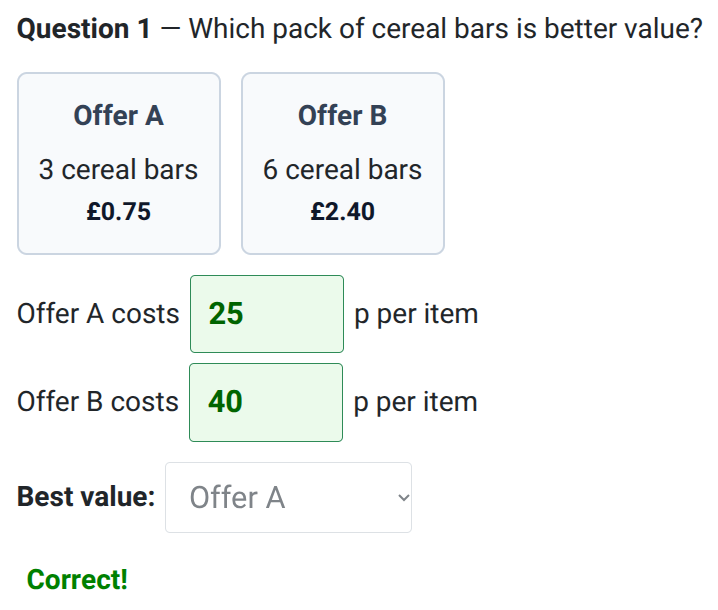
When shopping, the pack with the lowest price is not always the best value. To find the true best buy, you need to compare products using the same amount, such as the cost per item, the cost per 100 g, or the cost per 100 ml. In this worksheet, you will practise calculating and comparing these unit prices to find the best value. Jump to the questions
Practise now
Worksheet preview and key skills
Worksheet preview
Compare prices and quantities to find the best-value offer.
Calculate comparable unit costs such as pence per item, pence per 100 g, or pence per 100 ml, avoiding common traps like ignoring different pack sizes.
What you’ll practise
- calculating cost per item
- comparing cost per 100 g or 100 ml
- comparing different pack sizes
- comparing BOGOF and three-for-two offers
Use the interactive worksheet below, or read the Topic guide for the method and worked example.
Topic guide
What does best value mean?
The lowest pack price is not necessarily the best value. Best value means you get the most amount of product for your money, or you pay the lowest price for a specific amount of the product.
Compare the same amount
Both offers must be compared using the same unit. This is called a unit price. Common unit prices include:
- pence per item
- pence per 100 g
- pence per 100 ml
The lower comparable unit cost is the better value.
Finding cost per item
To calculate the unit price, use this simple formula:
price ÷ quantity
Worked example
Offer A: 4 pens for £1.20
Offer B: 6 pens for £1.68
Work out the cost in pence per pen for each offer (remember £1 = 100p):
Offer A: 120 ÷ 4 = 30p per pen
Offer B: 168 ÷ 6 = 28p per pen
Offer B is better value because 28p is less than 30p.
Comparing weights and volumes
When comparing weights (like grams) or volumes (like millilitres), it is often easiest to find the cost per 100 g or 100 ml, especially if the total weight is large.
Conversions
Make sure to keep your units consistent:
- £1 = 100 p
Special offers
Sometimes you need to work out the effective price when a special offer is applied:
- Buy one get one free (BOGOF): two items are received for the price of one. (Divide the single price by 2).
- Three for the price of two: three items are received for the price of two. (Multiply the single price by 2, then divide by 3).
Common mistakes
- Choosing the cheapest pack without comparing the actual quantities.
- Dividing quantity by price instead of price by quantity.
- Mixing pounds and pence (e.g. dividing £1.20 by 4 and getting 0.3, then getting confused about units). Always use pence when instructed!
- Rounding your answers too early, which makes two offers look the same.
- Forgetting to include the free item in a promotion when calculating how many items you receive.
Quick recap
Always calculate a unit cost: price ÷ quantity. Convert your units so both offers are using the same measurements. The lowest unit cost is the best value.