
Bounds
Practise upper and lower bounds in GCSE Higher calculations, with questions aimed at Grade 7. Apply measurement intervals to perimeter, circle area, speed, voltage and Pythagoras, then use both bounds to decide a suitable degree of accuracy for a density.
You should already be confident with rounding, significant figures and error intervals. Use a calculator and keep full precision until your final answer. Jump to the questions
Practise now
Worksheet preview and key skills
Worksheet preview
Eight calculator questions move from a brief lower-and-upper-bound check to Grade 7 applications involving formulae and right-angled triangles.
For example: a journey covers 286 m to the nearest metre in 19.4 seconds to 1 decimal place. Which distance and time bounds give the greatest possible speed? The final question asks you to justify a density by comparing its lower and upper bounds.
What you’ll practise
- Using different measurement accuracies in perimeter and circle area calculations.
- Selecting corresponding or opposite bounds in multiplication and division.
- Applying direct and rearranged Pythagoras with bounds.
- Reporting a derived value to an accuracy supported by both result bounds.
Use the interactive worksheet below, or read the Topic guide for the method and worked example.
Upper and lower bounds
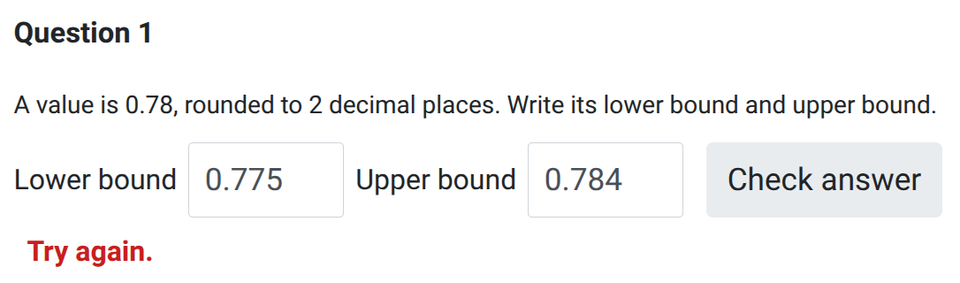
Use a calculator where needed and enter numbers only; units are supplied. Complete both fields in Questions 1 and 8.
Topic guide
From rounded measurements to calculated bounds
A rounded measurement represents an interval. Subtract half the rounding unit for its lower bound and add half for its upper bound. The upper endpoint is excluded: a length of 8.7 cm to the nearest millimetre means 8.65 ≤ length < 8.75 cm. One millimetre is 0.1 cm, so the half-unit is 0.05 cm.
All quantities here are positive. An upper bound describes the limiting endpoint even when that endpoint cannot be attained. Where asked, calculate that endpoint with full precision and round only the final answer.
Choose bounds to make the result as large or small as possible
- Addition: add lower bounds for a lower result, or upper bounds for an upper result. For a rectangle, apply this to 2(length + width).
- Multiplication: multiply lower bounds for a lower result, or upper bounds for an upper result. For a circle, an upper area bound is π times the square of the upper radius bound.
- Division: a larger numerator and smaller denominator give an upper result. A lower result uses the lower numerator and upper denominator.
- Subtraction: subtract the upper bound from the lower bound for a lower result; reverse the choices for an upper result.
Worked example: upper speed bound
A distance is 286 m to the nearest metre and a time is 19.4 s to 1 decimal place. Their intervals are 285.5 ≤ s < 286.5 and 19.35 ≤ t < 19.45.
For v = s ÷ t, the upper bound is 286.5 ÷ 19.35 = 14.806201… m/s. This is 14.8 m/s to 3 significant figures. Dividing both upper bounds would not give the upper speed bound.
Pythagoras: watch the subtraction
For legs a and b and hypotenuse c, c² = a² + b². The lower hypotenuse bound is √(aₗ² + bₗ²): use both lower leg bounds.
If b is unknown, rearrange first: b = √(c² − a²). Its lower bound is √(cₗ² − aᵤ²). Use a smaller hypotenuse and a larger known leg. For example, if a = 16.8 cm and c = 29.6 cm, each to 1 decimal place, the lower b bound is √(29.55² − 16.85²) = √589.28 ≈ 24.3 cm to 3 significant figures.
A suitable degree of accuracy
Calculate both result bounds before deciding how many digits to report. Suppose a sample has mass 528.0 g to 1 decimal place and volume 160 cm³ to the nearest cm³. Its lower density bound is 527.95 ÷ 160.5 = 3.289408… g/cm³; its upper bound is 528.05 ÷ 159.5 = 3.310658… g/cm³.
Both round to 3.3 g/cm³ to 1 decimal place. To 2 decimal places they give 3.29 and 3.31, so that greater precision is not justified. Question 8 asks for the greatest number of decimal places on which the two bounds agree. An answer such as 3.30 has the same numeric value, but the justified accuracy remains 1 decimal place.
Common mistakes to avoid
- Add or subtract exactly half the stated rounding unit, not a guessed final digit.
- Match the rounding unit to the units used in the calculation.
- For division and subtraction, choose opposite bounds rather than automatically taking both upper bounds.
- Use the calculator’s π key and keep intermediate values unrounded.
- A central estimate alone cannot establish a suitable degree of accuracy.