
Calculating one percent of an amount
Working out 1% of an amount is a handy skill that pops up more often than you’d think — whether you’re figuring out a small discount, estimating interest, or just splitting things fairly. It’s a simple step that helps build confidence with percentages in everyday life. Jump to the questions
Practise now
Worksheet preview and key skills
Worksheet preview
Practise calculating one percent of an amount with this self-marking maths worksheet.
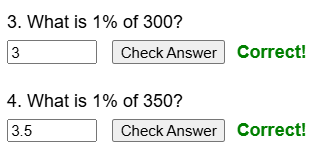
The interactive worksheet below generates questions, gives instant feedback, and lets students record their score.
What you’ll practise
- Understanding that 1% means one hundredth.
- Dividing the amount by 100.
- Using place value or decimal movement carefully.
- Writing the answer with suitable units where needed.
Use the interactive worksheet below, or read the Topic guide for the method and worked example.
Calculate 1% of the given amounts.
Topic guide
What this worksheet practises
This worksheet provides practice on finding 1% of an amount. Finding 1% is one of the most powerful mental maths tools you can learn. Once you can confidently find 1%, you can use it as a building block to calculate almost any other percentage, such as 3%, 7%, or 21%.
Key method
Percent means "out of 100". Therefore, 1% literally means 1 part out of 100.
- To find 1% of any number, you simply divide that number by 100.
- When dividing by 100, the digits move two places to the right across the place value columns.
- If there are zeroes at the end of a whole number, you can simply remove two zeroes.
- If there are no zeroes, you will need to add a decimal point.
Worked example
Find 1% of 450.
Step 1: Identify the calculation needed.
450 ÷ 100
Step 2: Move the digits two places to the right.
The 4 in the hundreds column moves to the units column.
The 5 in the tens column moves to the tenths column.
450 ÷ 100 = 4.5
The answer is 4.5.
Common mistakes to avoid
A frequent mistake is dividing by 10 instead of 100, which finds 10% rather than 1%. Ensure you move the digits two places, not just one. Another common error is misplacing the decimal point when the starting number already has a decimal, for example turning 2.5 into 0.25 instead of 0.025.
How to check your answer
If you multiply your 1% answer by 100, you should get back to your starting amount. If your answer was 4.5, 4.5 × 100 = 450. The check confirms the calculation is correct.