
Calculating the mean
Calculating the mean, or average, is a useful skill in everyday life—whether you're figuring out your test scores, tracking your favorite team's performance, or splitting the bill at a restaurant. It helps summarize a set of numbers into a single, easy-to-understand value, giving you a clear picture of the overall trend. Jump to the questions
Practise now
Worksheet preview and key skills
Worksheet preview
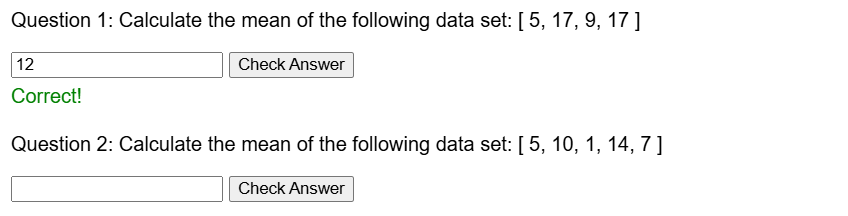
Practise calculating the mean with this self-marking maths worksheet.
The interactive worksheet below generates questions, gives instant feedback, and lets students record their score.
What you’ll practise
- Adding all the values.
- Counting how many values there are.
- Dividing the total by the number of values.
- Interpreting the mean as an average.
Use the interactive worksheet below, or read the Topic guide for the method and worked example.
All answers should be rounded to 1 decimal place.
Topic guide
What this worksheet practises
This worksheet provides practice on calculating the mean average from a list of numbers. The mean is the most commonly used measure of average. It is useful because it takes every single piece of data into account, giving a true central value for the entire dataset.
Key method
Calculating the mean is a two-step process: total everything up, then share it out equally.
- First, add all the numbers in the list together to find the total sum.
- Second, count how many numbers there are in the list.
- Finally, divide the total sum by the number of items.
Worked example
Find the mean of these five numbers: 4, 7, 2, 9, 3.
Step 1: Add all the numbers together.
4 + 7 + 2 + 9 + 3 = 25
Step 2: Count the numbers.
There are 5 numbers in the list.
Step 3: Divide the total sum by the count.
25 ÷ 5 = 5
The mean average is 5.
Common mistakes to avoid
A frequent mistake is miscounting the number of items in the list, especially when a number like zero is included. Remember that zero is a valid piece of data; you must include it in the sum (which changes nothing) but also count it as an item when dividing at the end. For example, the mean of 0, 4, 8 is (0+4+8)/3 = 4, not 12/2.
How to check your answer
Averages must always fall somewhere between the smallest and largest values in the list. In our example, the smallest number was 2 and the largest was 9. Our mean was 5. If your calculated mean is ever smaller than your lowest number or larger than your highest, you have definitely made an arithmetic error.