
Pythagoras' Theorem - mixed questions
The Pythagorean Theorem is a cornerstone of geometry, showing up wherever right-angled triangles are involved. It states that the square of the hypotenuse (the longest side) is equal to the sum of the squares of the other two sides. From designing ramps to navigating directly across a park, it’s a real-world tool for finding the shortest path or calculating distances. Jump to the questions
Practise now
Worksheet preview and key skills
Worksheet preview
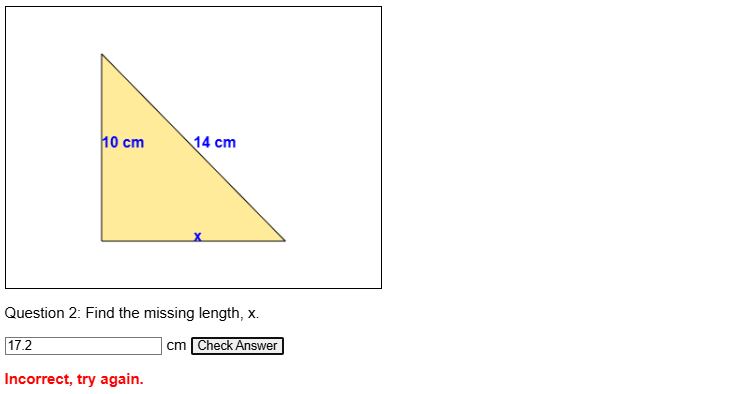
Practise mixed Pythagoras’ theorem questions with this self-marking maths worksheet.
The interactive worksheet below generates questions, gives instant feedback, and lets students record their score.
What you’ll practise
- Identifying the right-angled triangle.
- Choosing the hypotenuse or shorter side method.
- Using a² + b² = c².
- Square-rooting to find a missing length.
Use the interactive worksheet below, or read the Topic guide for the method and worked example.
Answers should be rounded to 1 decimal place.
Topic guide
What this worksheet practises
This worksheet provides mixed practice on Pythagoras' theorem. You will need to decide whether a question requires you to find the hypotenuse (the longest side) or a shorter side, and apply the correct form of the theorem.
Key method
Pythagoras' theorem is a² + b² = c², where 'c' is the hypotenuse.
- To find the hypotenuse: Square the other two sides, add them together, and then take the square root of the result. (c = √(a² + b²))
- To find a shorter side: Square the hypotenuse, subtract the square of the other known side, and then take the square root of the result. (a = √(c² − b²))
Worked example
Find the length of side 'a' in a right-angled triangle where the hypotenuse is 13 cm and the other side 'b' is 5 cm.
Step 1: Determine what you are finding. You are looking for a shorter side, so you must subtract.
Step 2: Set up the equation.
a² = 13² − 5²
Step 3: Square the numbers.
a² = 169 − 25 = 144
Step 4: Take the square root to find the length.
a = √144 = 12 cm
Common mistakes to avoid
A common error is to always add the squared numbers, regardless of which side needs finding. Always look carefully at the diagram: if the side opposite the right angle is already given, you must use subtraction.