
Finding shorter sides with Pythagoras' Theorem
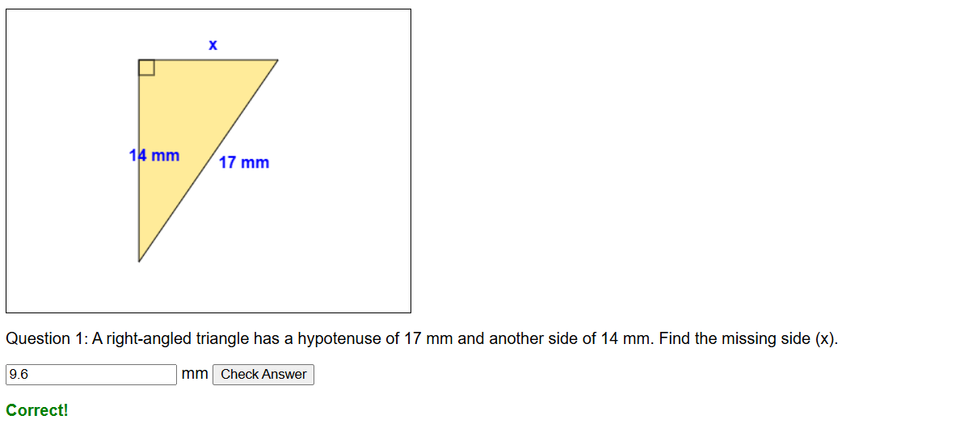
In real life, Pythagoras' theorem can help you solve problems like figuring out the length of a missing side in a right triangle, such as when designing ramps or calculating distances. Finding a shorter side is about working backward from the hypotenuse and another side to complete the triangle! Jump to the questions
Practise now
Worksheet preview and key skills
Worksheet preview
Practise finding shorter sides using Pythagoras’ theorem with this self-marking maths worksheet.
The interactive worksheet below generates questions, gives instant feedback, and lets students record their score.
What you’ll practise
- Identifying the hypotenuse and known shorter side.
- Rearranging Pythagoras’ theorem.
- Subtracting squares to find the missing shorter side.
- Square-rooting the result.
Use the interactive worksheet below, or read the Topic guide for the method and worked example.
Answers should be rounded to 1 decimal place.
Topic guide
What this worksheet practises
This worksheet focuses on using Pythagoras' Theorem to find one of the shorter sides of a right-angled triangle. While finding the hypotenuse requires addition, finding a shorter side requires subtraction.
Key method
The standard formula is a² + b² = c² (where 'c' is the longest side, the hypotenuse).
- Identify the hypotenuse ('c'). This is always the longest side, directly opposite the right angle.
- Square the length of the hypotenuse.
- Square the length of the known shorter side.
- Subtract the smaller square from the larger square. This gives you the square of your missing side.
- Finally, take the square root of that answer to find the actual length of the missing side.
Worked example
A right-angled triangle has a hypotenuse of 13cm and a base of 5cm. Find the height.
Step 1: Square the hypotenuse.
13² = 169.
Step 2: Square the known shorter side.
5² = 25.
Step 3: Subtract to find the square of the missing side.
169 − 25 = 144.
Step 4: Square root the result.
√144 = 12.
The height is 12cm.
Common mistakes to avoid
The most common mistake is going on "autopilot" and adding the two squared numbers together instead of subtracting them. Adding them finds a new, even longer hypotenuse. If you are looking for a shorter side, you must subtract.
How to check your answer
Your calculated answer must be shorter than the hypotenuse given in the question. In our example, the hypotenuse is 13. Our answer is 12. Since 12 is less than 13, the answer is logically possible. If you accidentally added the squares and got √194 (approx 13.9), the fact it is longer than 13 proves it is wrong.