
Finding the hypotenuse with Pythagoras' Theorem
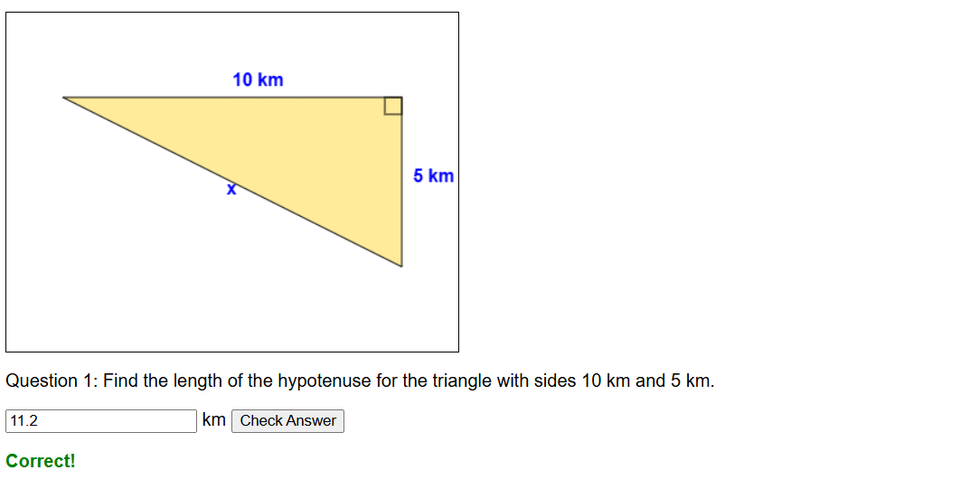
The hypotenuse is the longest side of a right-angled triangle, and Pythagoras' theorem helps us find it. Whether you're measuring the diagonal of a TV screen or figuring out the shortest distance across a park, this formula a² + b² = c² is a practical tool for solving real-world problems involving right triangles! Jump to the questions
Practise now
Worksheet preview and key skills
Worksheet preview
Practise finding the hypotenuse using Pythagoras’ theorem with this self-marking maths worksheet.
The interactive worksheet below generates questions, gives instant feedback, and lets students record their score.
What you’ll practise
- Identifying the two shorter sides.
- Using a² + b² = c².
- Adding the squares of the shorter sides.
- Square-rooting to find the hypotenuse.
Use the interactive worksheet below, or read the Topic guide for the method and worked example.
Answers should be rounded to 1 decimal place.
Topic guide
What this worksheet practises
This worksheet focuses on using Pythagoras' Theorem to find the hypotenuse of a right-angled triangle. The hypotenuse is always the longest side, and it is always situated directly opposite the 90-degree right angle.
Key method
The standard formula is a² + b² = c² (where 'c' represents the hypotenuse).
- Identify the two shorter sides (the base and the height). These are 'a' and 'b'.
- Square the length of the first shorter side.
- Square the length of the second shorter side.
- Add the two squared numbers together. This gives you the square of the hypotenuse (c²).
- Finally, take the square root of that answer to find the actual length of the hypotenuse ('c').
Worked example
A right-angled triangle has a base of 6cm and a height of 8cm. Find the length of the hypotenuse.
Step 1: Square the first shorter side.
6² = 36.
Step 2: Square the second shorter side.
8² = 64.
Step 3: Add the two squares together.
36 + 64 = 100.
Step 4: Square root the result.
√100 = 10.
The hypotenuse is 10cm.
Common mistakes to avoid
A very common error is forgetting the final step: taking the square root. Students will often add the squares together to get 100, and state that the side length is 100cm. Look at your triangle visually—if the other sides are 6cm and 8cm, a side of 100cm is physically impossible. You must always square root at the very end.
How to check your answer
By definition, the hypotenuse must be the longest side of the triangle. Your calculated answer must be a number larger than either of the two starting numbers. If it isn't, you have likely subtracted instead of adding.