
Truncation
Truncation is a way of simplifying numbers by cutting off extra decimal places or digits, often used in calculations to save time or achieve a specific level of accuracy. You might see truncation in action when rounding financial figures, measuring distances, or programming computers to work with manageable numbers. Jump to the questions
Practise now
Worksheet preview and key skills
Worksheet preview
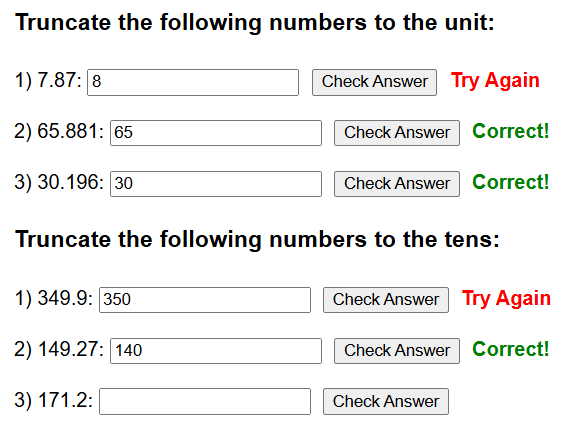
Practise truncation with this self-marking maths worksheet.
The interactive worksheet below generates questions, gives instant feedback, and lets students record their score.
What you’ll practise
- Cutting a number off at the required place value or decimal place.
- Distinguishing truncation from rounding.
- Keeping digits before the cut-off point unchanged.
- Writing the truncated value accurately.
Use the interactive worksheet below, or read the Topic guide for the method and worked example.
Topic guide
What this worksheet practises
This worksheet focuses on "truncating" numbers. Truncation is a very blunt, aggressive form of rounding. Instead of looking at a "decider" digit to see if a number should round up, truncation simply chops off everything after a certain point and ignores it completely.
Key method
Truncation does not care what the following digits are; it never rounds up.
- Identify the position you are asked to truncate to (e.g., 2 decimal places, or 1 significant figure).
- Find that exact digit in the number.
- Imagine a solid wall immediately after that digit.
- Chop off and delete every single digit that falls behind the wall. Do not look at them, do not use them to round up.
- If you are truncating a large whole number (e.g., to the nearest 1000), replace the chopped digits with placeholder zeroes to keep the number the right size.
Worked example
1) Truncate 14.899 to 1 decimal place.
2) Truncate 5,682 to 1 significant figure.
Example 1: (14.899 to 1 d.p.)
Step 1: The 1st decimal place is the 8. Draw the wall after the 8: 14.8 | 99
Step 2: Chop off the 99 entirely. (Note: standard rounding would make this 14.9, but truncation does not care).
The answer is 14.8.
Example 2: (5,682 to 1 s.f.)
Step 1: The 1st significant figure is the 5. Draw the wall after the 5: 5 | 682
Step 2: Chop off the 682. We must use placeholder zeroes because 5,682 is in the thousands.
The answer is 5,000.
Common mistakes to avoid
The most common mistake is simply forgetting that truncation is different from normal rounding. If a student is asked to truncate 7.96 to 1 d.p., habit will force them to round it up to 8.0. You must fight this habit. Truncation means CHOP. The answer is 7.9.
Things to remember
Truncation is often used in computers or digital displays when there is limited screen space. If a calculator screen can only show 5 digits, and the answer is 1.666666, it will simply truncate it to 1.6666, rather than doing the complicated arithmetic to round the final digit up to a 7.