
Rounding small numbers to two significant figures
Rounding small numbers to two significant figures is a crucial skill in science, engineering, and everyday problem-solving. It helps simplify calculations while keeping the results precise enough for practical use. For instance, when dealing with measurements like 0.00456 grams, rounding makes the data easier to interpret and communicate accurately. Jump to the questions
Practise now
Worksheet preview and key skills
Worksheet preview
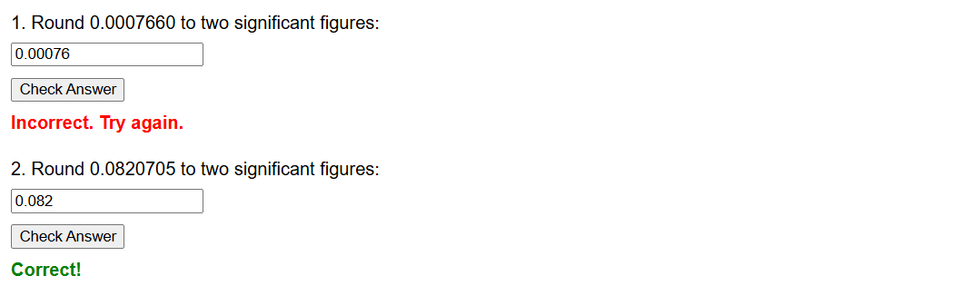
Practise rounding small numbers to two significant figures with this self-marking maths worksheet.
The interactive worksheet below generates questions, gives instant feedback, and lets students record their score.
What you’ll practise
- Identifying the first two significant digits.
- Looking at the next digit to decide whether to round up.
- Rounding small decimal numbers accurately.
- Keeping the correct number of decimal places or zeros.
Use the interactive worksheet below, or read the Topic guide for the method and worked example.
Answer the following questions by rounding each small number (between 0 and 1) to two significant figures.
Topic guide
What this worksheet practises
This worksheet provides practice on rounding very small decimals (e.g., 0.00746) to two significant figures. This is a common requirement in science when dealing with tiny measurements. The key is remembering that leading zeroes are never significant.
Key method
You must skip the leading zeroes to find where to start counting.
- Read the decimal from left to right. Ignore the zero before the decimal point, and ignore any zeroes immediately after it.
- The very first digit that is not a zero is your 1st significant figure.
- The digit immediately to its right is your 2nd significant figure. (Note: A zero does count here if it is the second digit, e.g., in 0.0408, the 0 after the 4 is the 2nd significant figure).
- Look at the digit immediately to the right of your 2nd significant figure. This is the "decider".
- If the decider is 5 or more, round the 2nd significant figure up. If it is 4 or less, keep it the same.
- Keep all leading zeroes, write your two significant digits, and drop all remaining numbers. Do not add trailing zeroes.
Worked example
Round 0.00518 to 2 significant figures.
Step 1: Read from left to right. Skip the 0.00. The first non-zero digit is 5. The next digit is 1.
The 1st s.f. is 5. The 2nd s.f. is 1.
Step 2: Look at the decider to the right of the 1. It is an 8.
Step 3: Because 8 is five or more, we round the 1 up to a 2.
Step 4: Keep the leading zeroes, write the 5 and the new 2, and drop the 8.
The final answer is 0.0052.
Common mistakes to avoid
The most common mistake is counting from the decimal point instead of the first non-zero number. A student asked to round 0.00518 to 2 sig figs might wrongly look at the two zeroes after the point and write 0.00. Significant figures only start when the number actually "begins" with a real value.
Things to remember
If you are asked to round 0.0496 to 2 sig figs, the decider is 6, so the 9 rounds up to 10. The 1 carries over, making the 4 a 5. The answer is 0.050. In this specific case, you must write the zero at the end (0.050) because it is the 2nd significant figure, proving your level of accuracy.