
Rounding small numbers to one significant figure
Rounding small numbers to one significant figure helps simplify calculations and make values easier to understand, especially when dealing with tiny measurements in science or engineering. For example, estimating the thickness of a hair or the diameter of a bacterium often requires rounding to make comparisons more practical! Jump to the questions
Practise now
Worksheet preview and key skills
Worksheet preview
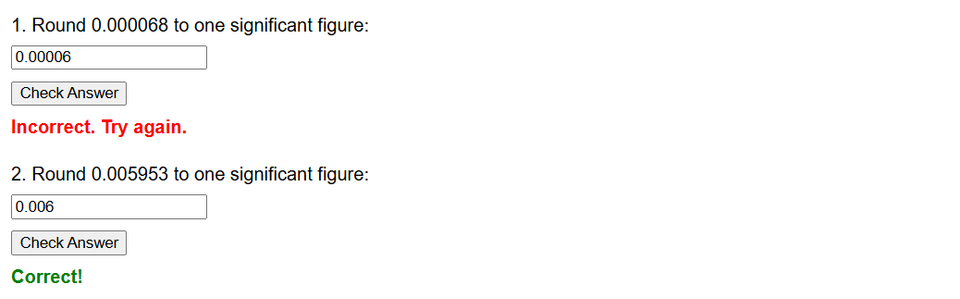
Practise rounding small numbers to one significant figure with this self-marking maths worksheet.
The interactive worksheet below generates questions, gives instant feedback, and lets students record their score.
What you’ll practise
- Identifying the first non-zero significant digit.
- Looking at the next digit to decide whether to round up.
- Rounding small decimal numbers accurately.
- Keeping the correct number of decimal places or zeros.
Use the interactive worksheet below, or read the Topic guide for the method and worked example.
Answer the following questions by rounding each small number (between 0 and 1) to one significant figure.
Topic guide
What this worksheet practises
This worksheet focuses on rounding very small decimal numbers (numbers starting with 0.0...) to a single significant figure. This is often confusing because students naturally want to start counting immediately after the decimal point.
Key method
The golden rule of significant figures is that leading zeroes do not count.
- Read the decimal from left to right. Ignore the zero before the decimal point, and ignore any zeroes immediately after it.
- The very first digit that is not a zero is your 1st significant figure.
- Look at the digit immediately to its right (the "decider").
- If the decider is 5 or more, round the 1st significant figure up. If it is 4 or less, keep it the same.
- Crucial Step: You must keep all the leading zeroes exactly where they were, but you completely delete any digits that came after your rounded number. Do not use placeholder zeroes at the end of a decimal.
Worked example
Round 0.00382 to 1 significant figure.
Step 1: Read from left to right. Skip the 0.00. The first non-zero digit is 3. This is the 1st significant figure.
Step 2: Look at the decider to the right. It is an 8.
Step 3: Because 8 is five or more, we round the 3 up to a 4.
Step 4: Keep the leading zeroes, write the new 4, and drop the rest.
The final answer is 0.004.
Common mistakes to avoid
The two most common errors are:
1) Treating it like "1 decimal place" and rounding 0.00382 to 0.0.
2) Adding zeroes to the end of the decimal (e.g. 0.00400). Adding zeroes to the end of a decimal implies a false level of accuracy. You must drop the trailing digits entirely.
How to check your answer
Your final answer for "1 significant figure" should only ever contain a single non-zero number, no matter how many leading zeroes it has (e.g. 0.0000007). If your answer has two non-zero digits (like 0.0042), you have rounded to 2 significant figures by mistake.