
Rounding larger numbers to three significant figures
Rounding large numbers to three significant figures is a vital skill in science, engineering, and everyday life. It helps simplify complex calculations while maintaining accuracy. For example, if you're estimating the population of a city or the distance between planets, using significant figures ensures clarity without overwhelming you with unnecessary detail. Jump to the questions
Practise now
Worksheet preview and key skills
Worksheet preview
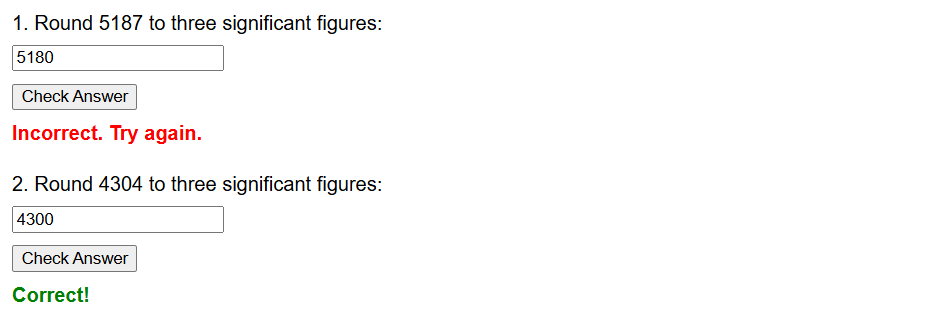
Practise rounding larger numbers to three significant figures with this self-marking maths worksheet.
The interactive worksheet below generates questions, gives instant feedback, and lets students record their score.
What you’ll practise
- Identifying the first three significant digits.
- Looking at the next digit to decide whether to round up.
- Rounding large numbers to the correct place value.
- Writing the rounded number with the correct number of zeros.
Use the interactive worksheet below, or read the Topic guide for the method and worked example.
Answer the following questions by rounding each number to three significant figures.
Topic guide
What this worksheet practises
This worksheet provides practice on rounding large numbers (greater than 1) to three significant figures. This level of precision is the standard requirement for almost all final answers in higher-level maths and science exams, unless told otherwise.
Key method
The method requires you to count three places from the start of the number.
- Look at the number from left to right. The very first non-zero digit is the 1st significant figure.
- Count along to the right. The next digit is the 2nd, and the one after that is the 3rd significant figure. (Note: A zero does count as a significant figure if it is trapped between or after other non-zero digits).
- Look at the digit immediately to the right of your 3rd significant figure (the "decider").
- If the decider is 5 or more, round the 3rd significant figure up. If it is 4 or less, keep it the same.
- Replace any remaining whole-number digits with placeholder zeroes.
Worked example
Round 80,452 to 3 significant figures.
Step 1: Find the 3rd significant figure. The 8 is the 1st, the 0 is the 2nd, and the 4 is the 3rd.
Step 2: Look at the decider to the right of the 4. It is a 5.
Step 3: Because the decider is 5, we round the 4 up to a 5.
Step 4: The first three digits are now 805. We need two placeholder zeroes to maintain the original size of the number (tens of thousands).
The final answer is 80,500.
Common mistakes to avoid
A frequent error occurs when rounding causes a "chain reaction". For example, rounding 12,981 to 3 sig figs. The 3rd figure is 9. The decider is 8, so the 9 must round up to 10. You cannot write "10" in one column, so the 9 becomes a 0, and you carry the 1 over to the 2, making it a 3. The correct answer is 13,000.
How to check your answer
Your final answer should generally contain exactly three non-zero digits (though ending in zeroes is fine). It must also be roughly the same size as the number you started with.