
Rounding larger numbers to two significant figures
Rounding to two significant figures is a way to simplify numbers while keeping their most important digits. It's especially useful in science and engineering when working with large or small measurements, like calculating distances in space or reporting lab results. By focusing on just two key digits, you can quickly estimate and communicate values without losing their essential meaning. Jump to the questions
Practise now
Worksheet preview and key skills
Worksheet preview
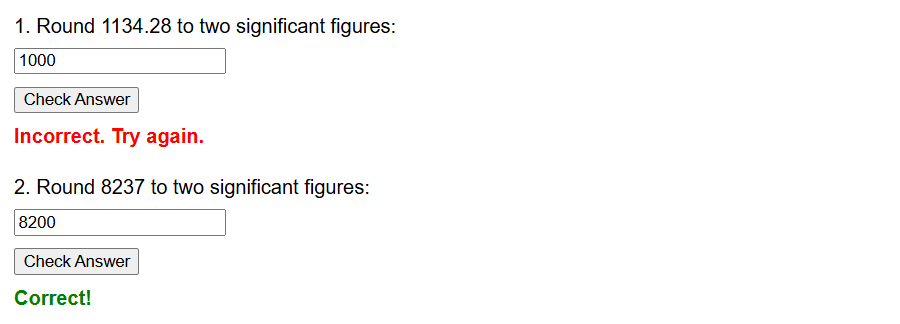
Practise rounding larger numbers to two significant figures with this self-marking maths worksheet.
The interactive worksheet below generates questions, gives instant feedback, and lets students record their score.
What you’ll practise
- Identifying the first two significant digits.
- Looking at the next digit to decide whether to round up.
- Rounding large numbers to the correct place value.
- Writing the rounded number with the correct number of zeros.
Use the interactive worksheet below, or read the Topic guide for the method and worked example.
Answer the following questions by rounding each number to two significant figures.
Topic guide
What this worksheet practises
This worksheet focuses on rounding numbers greater than 1 to two significant figures. This provides a balance between extreme estimation (1 sig fig) and high precision (3 sig figs).
Key method
You must locate the second most important digit in the number.
- Read the number from left to right. The first digit is the 1st significant figure. The digit immediately next to it is the 2nd significant figure.
- Look at the digit immediately to the right of your 2nd significant figure. This is your "decider".
- If the decider is 5 or more, round your 2nd significant figure up by one.
- If the decider is 4 or less, keep your 2nd significant figure the same.
- Replace any remaining digits before the decimal point with placeholder zeroes to ensure the number stays the correct size.
Worked example
Round 314,920 to 2 significant figures.
Step 1: Find the 2nd significant figure. The 3 is the 1st, so the 1 is the 2nd.
Step 2: Look at the decider to the right. It is a 4.
Step 3: Because 4 is less than 5, the 1 stays exactly as it is.
Step 4: The first two digits remain 31. We need four placeholder zeroes to replace the 4920 and keep the number in the "hundred thousands".
The final answer is 310,000.
Common mistakes to avoid
A common mistake is "double rounding" from the end of the number. In the example 314,920, a student might see the 9, round the 4 up to a 5, and then use that new 5 to round the 1 up to a 2. This is completely wrong. You only ever look at the single decider digit immediately next to your target. The 9 is entirely irrelevant.
Things to remember
If you are asked to round a number like 49,600 to 2 significant figures, the decider is 6, so the 9 rounds up to 10. The 1 carries over, making the 4 a 5. The answer is 50,000. Even though 50,000 looks like it only has 1 significant figure, in this specific context, the first zero is technically the 2nd significant figure.