
Rounding larger numbers to one significant figure
Rounding larger numbers to one significant figure helps simplify complex calculations, especially when estimating in real-world situations. For example, when budgeting for a big event or calculating the population of a city, using rounded numbers gives a quick and clear idea without unnecessary detail. Jump to the questions
Practise now
Worksheet preview and key skills
Worksheet preview
Practise rounding larger numbers to one significant figure with this self-marking maths worksheet.
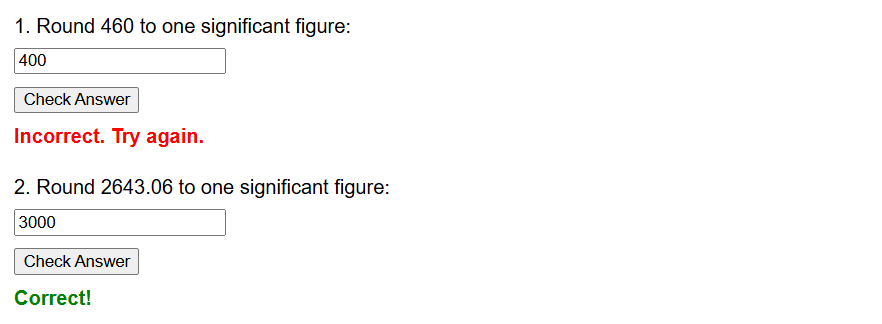
The interactive worksheet below generates questions, gives instant feedback, and lets students record their score.
What you’ll practise
- Identifying the first significant digit.
- Looking at the next digit to decide whether to round up.
- Rounding large numbers to the correct place value.
- Writing the rounded number with the correct number of zeros.
Use the interactive worksheet below, or read the Topic guide for the method and worked example.
Answer the following questions by rounding each number to one significant figure.
Topic guide
What this worksheet practises
This worksheet focuses on rounding numbers greater than 1 to a single significant figure. This is an essential skill for estimating calculations. A significant figure represents the most "valuable" or "heavy" digit in a number.
Key method
Finding the first significant figure in a large number is straightforward: it is always the very first non-zero digit on the left.
- Look at the number from left to right. The very first digit you see (which will not be a zero for numbers greater than 1) is the 1st significant figure.
- Look at the single digit immediately to its right (the "decider").
- If the decider is 5 or more, round the 1st significant figure up by one.
- If the decider is 4 or less, keep the 1st significant figure the same.
- Replace all other digits after the 1st significant figure with placeholder zeroes up to the decimal point to keep the number the right size.
Worked example
Round 4,729 to 1 significant figure.
Step 1: Find the 1st significant figure. It is the 4.
Step 2: Look at the decider to the right. It is a 7.
Step 3: Because 7 is five or more, we round the 4 up to a 5.
Step 4: The 4 was in the thousands column. We must add three placeholder zeroes to keep the 5 in the thousands column.
The final answer is 5,000.
Common mistakes to avoid
The most catastrophic mistake is forgetting the placeholder zeroes. If a student rounds 4,729 to "5", they have fundamentally changed the size of the number. 4,729 is roughly five thousand, not five.
Things to remember
Rounding to 1 significant figure essentially asks: "Is this number closer to 4000 or 5000? Is it closer to 60 or 70?". Your final answer will always be a single digit followed by zeroes.