
Cancelling down fractions to their simplest form
Simplifying fractions is a crucial skill in math that helps make numbers easier to work with. Whether you're baking with recipes, comparing discounts while shopping, or solving puzzles, knowing how to reduce fractions to their simplest form ensures calculations are quick and accurate in everyday life. Jump to the questions
Practise now
Worksheet preview and key skills
Worksheet preview
Practise cancelling down fractions to their simplest form with this self-marking maths worksheet.
The interactive worksheet below generates questions, gives instant feedback, and lets students record their score.
What you’ll practise
- Finding a common factor of the numerator and denominator.
- Dividing both parts by the same number.
- Simplifying until no common factor remains.
- Writing the fraction in its simplest form.
Use the interactive worksheet below, or read the Topic guide for the method and worked example.
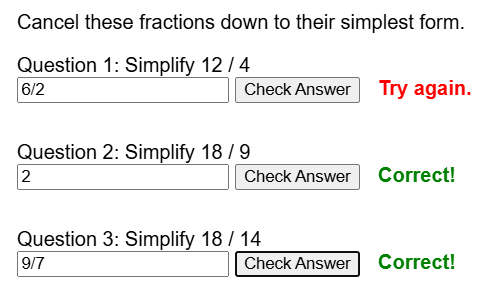
Cancel these fractions down to their simplest form.
Topic guide
What this worksheet practises
This worksheet provides practice on cancelling down fractions to their simplest form. Simplifying fractions is a fundamental mathematical skill; almost all fraction questions in an exam require you to leave your final answer in its simplest form.
Key method
To cancel down a fraction, you must find a common factor that divides equally into both the numerator (the top number) and the denominator (the bottom number).
- Identify a number that goes into both the top and the bottom without leaving a remainder.
- Divide both the numerator and the denominator by this number.
- Check the new fraction to see if it can be divided again. Repeat the process until the only common factor left is 1.
- If you can spot the highest common factor (HCF) immediately, you can simplify the fraction in a single step.
Worked example
Simplify the fraction 24/36 fully.
Step 1: Notice that both numbers are even, so they can be halved (divided by 2).
24 ÷ 2 = 12, and 36 ÷ 2 = 18. This gives 12/18.
Step 2: Both are still even, so halve them again.
12 ÷ 2 = 6, and 18 ÷ 2 = 9. This gives 6/9.
Step 3: 6 and 9 are both in the 3 times table. Divide by 3.
6 ÷ 3 = 2, and 9 ÷ 3 = 3. This gives 2/3.
There are no more common factors, so the simplest form is 2/3.
(Alternatively, dividing immediately by the HCF, which is 12: 24 ÷ 12 = 2, and 36 ÷ 12 = 3).
Common mistakes to avoid
A frequent mistake is stopping too early. Students often divide by 2 or 3 once and assume the fraction is fully simplified. Always check your resulting fraction to guarantee no further common factors exist.
How to check your answer
Look closely at your final numerator and denominator. If they are both even, you definitely haven't finished. If one is a prime number (like 2, 3, 5, or 7), check if it divides into the other number. If it doesn't, your fraction is fully simplified.