
Finding the endpoint when given a midpoint
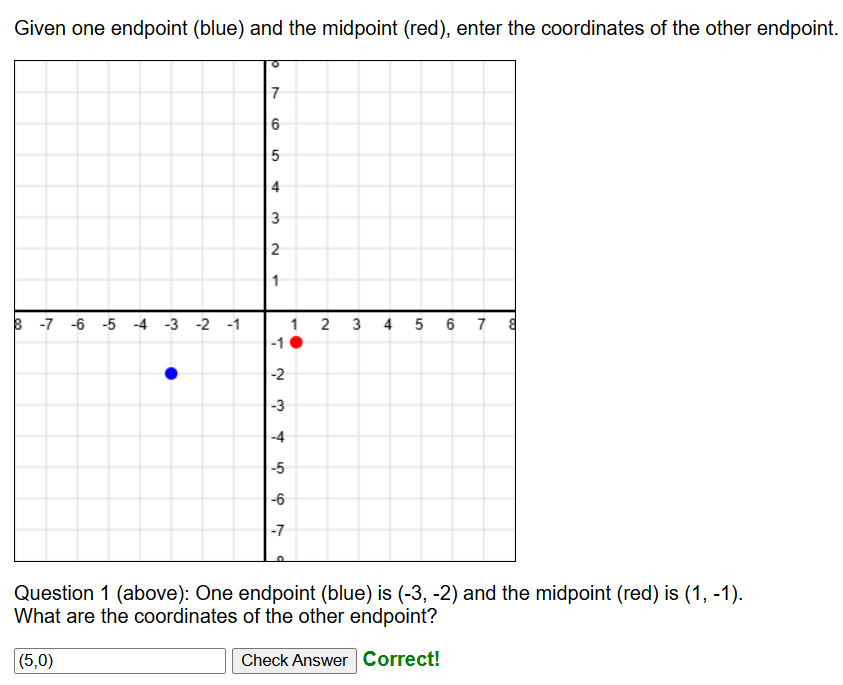
Finding the endpoint of a line segment when the midpoint is given is a useful skill in geometry and coordinate geometry. It often arises in tasks like map plotting or computer graphics when you're determining symmetry or completing shapes. By using simple algebraic formulas, you can calculate the endpoint that balances the midpoint perfectly between the two points. Jump to the questions
Practise now
Worksheet preview and key skills
Worksheet preview
Practise finding the endpoint when given a midpoint with this self-marking maths worksheet.
The interactive worksheet below generates questions, gives instant feedback, and lets students record their score.
What you’ll practise
- Using the known endpoint and midpoint.
- Finding the change in x and y.
- Continuing the same distance past the midpoint.
- Writing the missing endpoint as a coordinate pair.
Use the interactive worksheet below, or read the Topic guide for the method and worked example.
Given one endpoint (blue) and the midpoint (red), enter the coordinates of the other endpoint. Remember to include brackets in your answer!
Topic guide
What this worksheet practises
This worksheet focuses on a slightly backwards coordinate geometry problem. Usually, you are given two endpoints and asked to find the middle. Here, you are given one endpoint and the middle, and must work outwards to find the other missing endpoint.
Key method
Think of this physically: the distance you travel from the start point to get to the middle, is the exact same distance you must continue travelling to reach the end.
- Look at the x-coordinates first. Calculate the gap from your known start point to the midpoint.
- Add that exact same gap onto the midpoint to find your missing x-coordinate. (Be careful with negative directions).
- Repeat the exact same process for the y-coordinates. Calculate the gap from the start y to the middle y.
- Add that gap onto the middle y to find your final y-coordinate.
Worked example
A line segment starts at A(2, 5). The midpoint of the line is M(6, 9). Find the coordinates of the endpoint B.
Step 1: Calculate the jump for the x-coordinates.
Start x is 2. Middle x is 6. The jump is +4.
Step 2: Apply that jump from the middle to find the end x.
6 + 4 = 10. The missing x-coordinate is 10.
Step 3: Calculate the jump for the y-coordinates.
Start y is 5. Middle y is 9. The jump is +4.
Step 4: Apply that jump from the middle to find the end y.
9 + 4 = 13. The missing y-coordinate is 13.
The endpoint B is at (10, 13).
Common mistakes to avoid
A frequent error is applying the midpoint formula (adding the coordinates and dividing by 2) to the start point and the midpoint. This calculates the middle of the first half of the line, not the endpoint. You must use the "jumping" method described above.
How to check your answer
Once you have found your endpoint, use the standard midpoint formula on your start point and your new endpoint to see if you arrive back at the midpoint given in the question. In our example, (2 + 10)/2 = 6, and (5 + 13)/2 = 9. This perfectly matches the midpoint M(6, 9).