
Finding the gradient
The gradient of a straight line tells us how steep the line is and whether it slopes up or down. You’ll often use gradients in real life to calculate slopes on a hill, design ramps, or analyze trends on a graph, like how quickly something increases or decreases over time. Jump to the questions
Practise now
Worksheet preview and key skills
Worksheet preview
Practise finding the gradient with this self-marking maths worksheet.
The interactive worksheet below generates questions, gives instant feedback, and lets students record their score.
What you’ll practise
- Reading two points on a line.
- Finding the change in y.
- Finding the change in x.
- Using gradient = change in y / change in x.
Use the interactive worksheet below, or read the Topic guide for the method and worked example.
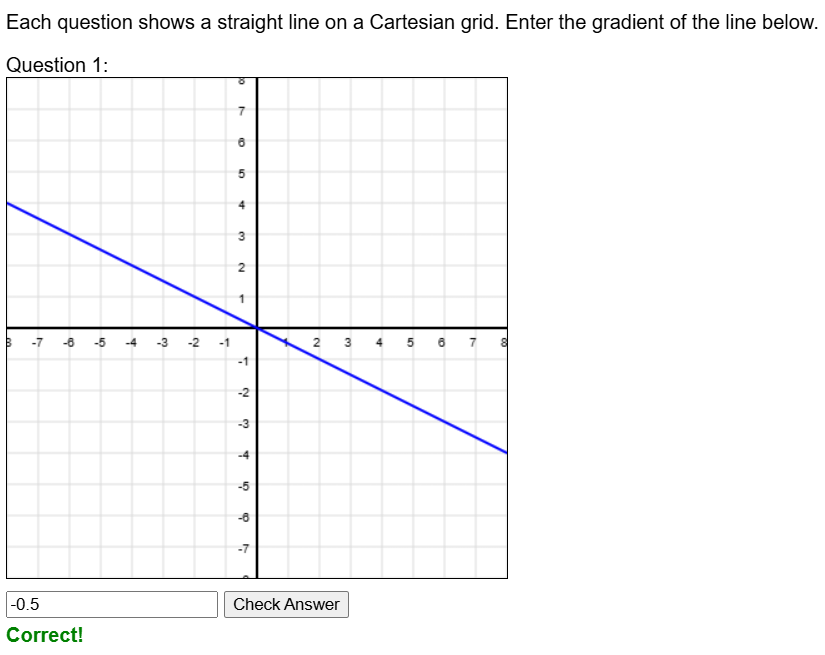
Each question shows a straight line on a Cartesian grid. Enter the gradient of the line below.
Topic guide
What this worksheet practises
This worksheet provides practice on calculating the gradient (steepness) of a straight line when given two coordinate points. The gradient is the 'm' in the equation y = mx + c and is a fundamental concept in coordinate geometry.
Key method
The gradient is a measure of how far a line goes UP for every one unit it goes ACROSS. We calculate it using the formula: Gradient = (Change in y) ÷ (Change in x).
- Identify your two coordinate points, (x₁, y₁) and (x₂, y₂).
- Calculate the "Change in y" by subtracting the y-coordinates: (y₂ − y₁). This is the vertical rise.
- Calculate the "Change in x" by subtracting the x-coordinates: (x₂ − x₁). This is the horizontal run. You must subtract them in the exact same order you used for the y-coordinates.
- Divide the change in y by the change in x.
Worked example
Find the gradient of the line connecting (2, 5) and (6, 17).
Step 1: Calculate the change in y (the rise).
17 − 5 = 12.
Step 2: Calculate the change in x (the run). Make sure to start with the 6, since we started with the 17.
6 − 2 = 4.
Step 3: Divide the change in y by the change in x.
Gradient (m) = 12 ÷ 4 = 3.
Common mistakes to avoid
The most devastating mistake is putting the x's on the top and the y's on the bottom (calculating run divided by rise). This calculates the inverse of the gradient. Always remember the phrase "rise over run": the y-axis is the rise, so the y-coordinates must always be on the top of the fraction.
Things to remember
A positive gradient means the line goes uphill from left to right. A negative gradient means it goes downhill. If you calculate a negative change in y, don't ignore the minus sign; it is vital information about the direction of the line.