
Multiplying fractions
Multiplying fractions is a practical skill that often comes up in real life, like when you're adjusting recipes, calculating portions, or working with measurements. It’s all about breaking things into parts and combining them—perfect for understanding how pieces fit together in the world around us! Jump to the questions
Practise now
Worksheet preview and key skills
Worksheet preview
Practise multiplying fractions with this self-marking maths worksheet.
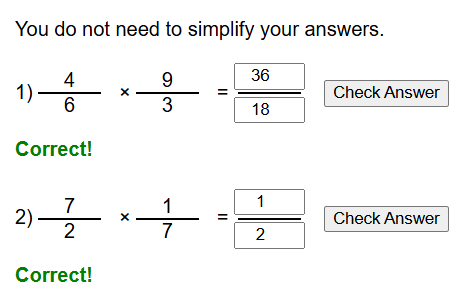
The interactive worksheet below generates questions, gives instant feedback, and lets students record their score.
What you’ll practise
- Multiplying the numerators.
- Multiplying the denominators.
- Simplifying before or after multiplying where possible.
- Writing the final answer as a fraction.
Use the interactive worksheet below, or read the Topic guide for the method and worked example.
Multiply the following fractions. You do not need to simplify your answers.
Topic guide
What this worksheet practises
This worksheet focuses on the core skill of multiplying two basic fractions together. Unlike addition and subtraction, multiplication does not require the denominators (the bottom numbers) to be the same.
Key method
The rule for multiplying fractions is to multiply horizontally straight across.
- Take the two numerators (the top numbers) and multiply them together. This becomes the top number of your answer.
- Take the two denominators (the bottom numbers) and multiply them together. This becomes the bottom number of your answer.
- Write the new numbers as a single fraction.
Worked example
Calculate 2/5 × 3/7.
Step 1: Multiply the top numbers.
2 × 3 = 6. Our new top number is 6.
Step 2: Multiply the bottom numbers.
5 × 7 = 35. Our new bottom number is 35.
Step 3: Write the final answer.
The answer is 6/35.
Common mistakes to avoid
A very common error is "cross-multiplying" (multiplying the top left by the bottom right, and the bottom left by the top right). This technique is used for dividing fractions, or for checking if fractions are equivalent, but it is completely wrong for multiplying. Always multiply straight across: top by top, bottom by bottom.
Things to remember
Multiplying by a fraction smaller than 1 will always make your starting number smaller. This can feel confusing because we are used to multiplication making things bigger. However, "half times a half" means you are taking a half, and cutting it in half again. The result (a quarter) is physically smaller than what you started with.