
Multiplying fractions and then simplifying
Multiplying and simplifying fractions helps you work efficiently with parts of a whole. Whether you're scaling down a recipe or figuring out how much of a task is left after sharing it with friends, knowing how to multiply fractions and simplify the result is a valuable tool for making sense of proportions and real-world problems. Jump to the questions
Practise now
Worksheet preview and key skills
Worksheet preview
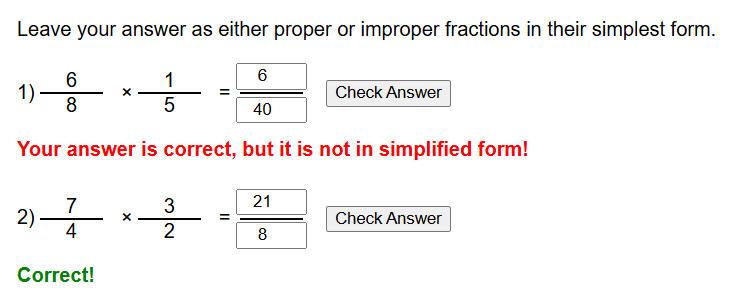
Practise multiplying fractions and then simplifying with this self-marking maths worksheet.
The interactive worksheet below generates questions, gives instant feedback, and lets students record their score.
What you’ll practise
- Multiplying the numerators and denominators.
- Looking for common factors.
- Cancelling down the result.
- Writing the answer in simplest form.
Use the interactive worksheet below, or read the Topic guide for the method and worked example.
Leave your answer as either proper or improper fractions in their simplest form.
Topic guide
What this worksheet practises
This worksheet provides practice on multiplying two fractions together and then ensuring the final answer is written in its simplest possible form. Multiplying fractions is generally considered easier than adding them, because you do not need to find a common denominator.
Key method
The rule for multiplying fractions is straightforward: multiply the top numbers, and multiply the bottom numbers.
- Multiply the two numerators (top numbers) together. This gives you your new numerator.
- Multiply the two denominators (bottom numbers) together. This gives you your new denominator.
- Simplify: Look at your final fraction. Find the Highest Common Factor (the largest number that divides exactly into both the top and the bottom).
- Divide both the numerator and the denominator by this Highest Common Factor to simplify the fraction fully.
Worked example
Calculate 3/4 × 8/9. Give your answer in its simplest form.
Step 1: Multiply the tops.
3 × 8 = 24.
Step 2: Multiply the bottoms.
4 × 9 = 36.
Step 3: Combine into a new fraction.
The answer is 24/36.
Step 4: Simplify. Both numbers divide by 12 (the Highest Common Factor).
24 ÷ 12 = 2.
36 ÷ 12 = 3.
The fully simplified answer is 2/3.
Common mistakes to avoid
The most common mistake is confusing multiplication with addition and trying to find a common denominator first (e.g. changing them both to 36ths before multiplying). While this isn't mathematically "wrong", it creates unnecessarily huge numbers that are extremely difficult to simplify later. Always just multiply straight across.
Things to remember
You can "cross-simplify" before you multiply to make the numbers smaller. In our example (3/4 × 8/9), the 3 on top and 9 on the bottom can both divide by 3 (becoming 1 and 3). The 4 on the bottom and 8 on the top can both divide by 4 (becoming 1 and 2). The calculation then becomes 1/1 × 2/3, which immediately gives the simplified answer 2/3.