
Multiplying mixed number fractions
Multiplying mixed number fractions might seem tricky at first, but it’s a skill that comes in handy in real life—like when you’re doubling a recipe or calculating materials for a project. By breaking these numbers into improper fractions, you can tackle them step by step and master another piece of the math puzzle! Jump to the questions
Practise now
Worksheet preview and key skills
Worksheet preview
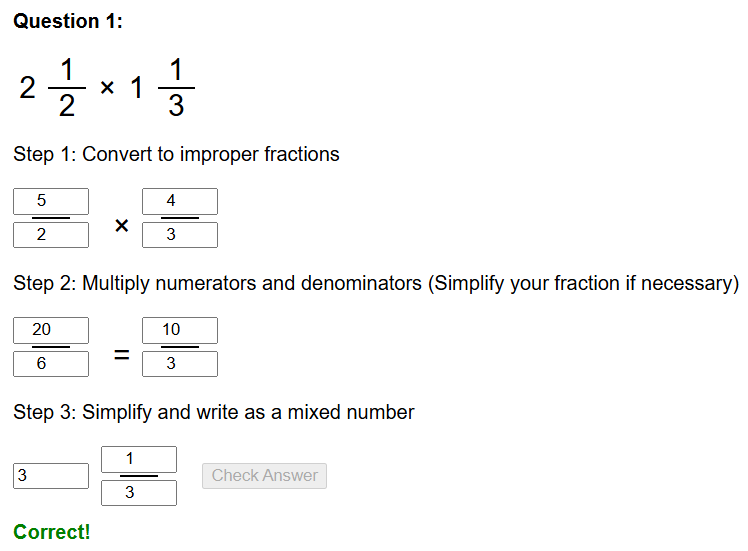
Practise multiplying mixed number fractions with this self-marking maths worksheet.
The interactive worksheet below generates questions, gives instant feedback, and lets students record their score.
What you’ll practise
- Converting mixed numbers to improper fractions first.
- Multiplying numerators and denominators.
- Simplifying before or after multiplying where possible.
- Converting the final answer where appropriate.
Use the interactive worksheet below, or read the Topic guide for the method and worked example.
Convert the mixed numbers to improper fractions, multiply, and simplify the result. Enter your final answer as a mixed number in its simplest form.
Topic guide
What this worksheet practises
This worksheet focuses on multiplying mixed numbers (e.g., 2½). You cannot simply multiply the whole numbers together and then multiply the fractions together; doing so mathematically ignores large parts of the calculation.
Key method
The only reliable method is to completely convert the mixed numbers into improper (top-heavy) fractions before you begin multiplying.
- Convert: To change a mixed number to an improper fraction, multiply the large whole number by the denominator (bottom number), and then add the numerator (top number). This is your new top number. The bottom number stays exactly the same.
- Convert both mixed numbers in the question.
- Multiply: Now multiply the two improper fractions together normally (top times top, bottom times bottom).
- Convert Back: Often, the question will ask for the answer as a mixed number. Divide your final top number by your bottom number to find the whole number, and put the remainder over the denominator.
Worked example
Calculate 1⅔ × 2¼.
Step 1: Convert 1⅔ into an improper fraction.
(1 × 3) + 2 = 5. The fraction is 5/3.
Step 2: Convert 2¼ into an improper fraction.
(2 × 4) + 1 = 9. The fraction is 9/4.
Step 3: Multiply the two new fractions (5/3 × 9/4).
Tops: 5 × 9 = 45.
Bottoms: 3 × 4 = 12.
The answer is 45/12.
Step 4: Simplify and convert back to a mixed number.
45 and 12 both divide by 3, simplifying to 15/4.
4 fits into 15 three times (3 × 4 = 12), with a remainder of 3.
The final answer is 3¾.
Common mistakes to avoid
The absolute most common mistake is attempting to multiply the whole numbers (1 × 2) and the fractions (2/3 × 1/4) separately, giving an answer of 2 and 2/12. This is entirely wrong. It is equivalent to calculating 13 × 24 by only doing 10 × 20 and 3 × 4, missing out the cross-multiplications. You must convert to improper fractions first.
How to check your answer
Use estimation. 1⅔ is a bit less than 2. 2¼ is a bit more than 2. Therefore, 2 × 2 = 4. Our calculated answer of 3¾ is extremely close to 4, which strongly suggests our calculation is correct.