
Dividing fractions
Dividing fractions might seem tricky at first, but it’s a skill you’ll use in real life more often than you think—like when splitting a recipe into smaller portions or figuring out how to divide tasks fairly. Once you master flipping and multiplying, you’ll see how simple it really is! Jump the questions
Practise now
Worksheet preview and key skills
Worksheet preview
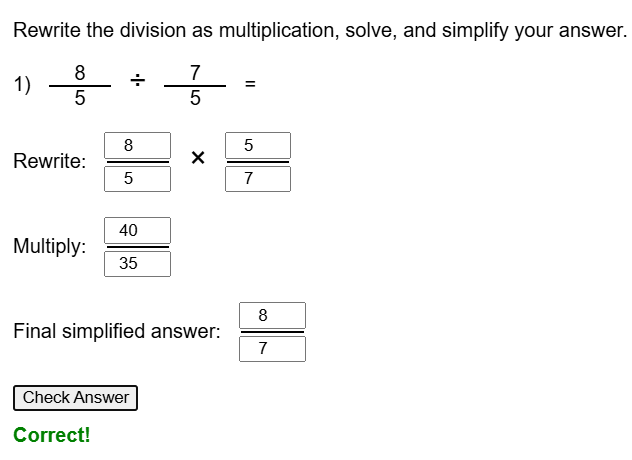
Practise dividing fractions with this self-marking maths worksheet.
The interactive worksheet below generates questions, gives instant feedback, and lets students record their score.
What you’ll practise
- Changing the division to multiplication by the reciprocal.
- Flipping the second fraction.
- Multiplying numerators and denominators.
- Simplifying the final answer where possible.
Use the interactive worksheet below, or read the Topic guide for the method and worked example.
Rewrite the division as multiplication, multiply, and simplify your answer. Leave your final answer as a proper or improper fraction in its simplest form.
Topic guide
What this worksheet practises
This worksheet provides practice on dividing fractions. Division of fractions is rarely done directly. Instead, we use a simple rule to turn the difficult division problem into an easy multiplication problem.
Key method
The standard method for dividing fractions is often remembered by the acronym KFC (Keep, Flip, Change).
- Keep the first fraction exactly as it is.
- Change the division sign (÷) into a multiplication sign (×).
- Flip the second fraction upside down (this is called finding its reciprocal).
- Multiply the two top numbers (numerators) together.
- Multiply the two bottom numbers (denominators) together.
- Simplify the final fraction if possible.
Worked example
Calculate 2/3 ÷ 4/5. Give your answer in its simplest form.
Step 1: Apply the KFC rule.
Keep 2/3.
Change ÷ to ×.
Flip 4/5 to 5/4.
The calculation becomes: 2/3 × 5/4.
Step 2: Multiply the numerators.
2 × 5 = 10.
Step 3: Multiply the denominators.
3 × 4 = 12.
The fraction is 10/12.
Step 4: Simplify. Both numbers are even, so halve them.
The final answer is 5/6.
Common mistakes to avoid
The most common mistake is flipping the first fraction instead of the second one. Another frequent error is forgetting to change the division sign to multiplication, causing confusion. Always strictly follow the Keep-Change-Flip order.
Things to remember
If you are dividing by a whole number, remember that you can write any whole number as a fraction over 1. For example, dividing by 3 is the same as dividing by 3/1. When you flip this, it becomes a multiplication by 1/3.